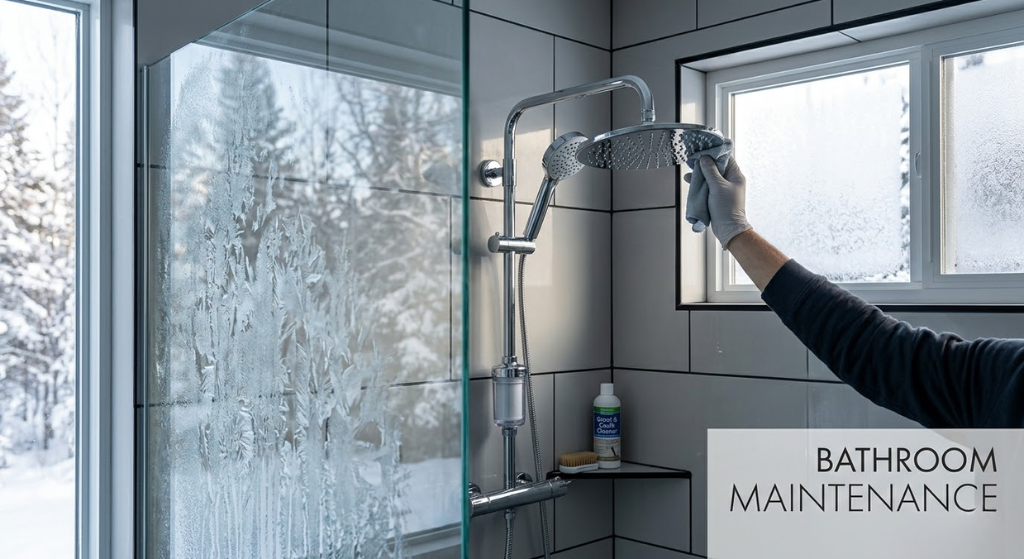
Four questions, four genuinely useful answers — and all four are interconnected by a single theme: how you treat your shower and how often you use it have compounding effects on your health, your home’s integrity, and your water quality. This guide covers all four in full, with exact recommendations backed by dermatologists, plumbing professionals, and filtration specialists.
All Four at a Glance
| Question | Recommended Frequency | Primary Driver | Key Warning Sign |
|---|---|---|---|
| Change shower head | Every 6–10 years | Material quality + water hardness + maintenance | Uneven spray, rust, persistent low pressure after descaling |
| Recaulk shower | Every 1–5 years | Usage frequency, ventilation, caulk quality | Cracking, peeling, visible mould, water seeping behind tiles |
| Replace filter cartridge | Every 3–6 months | Household size, shower frequency, water hardness | Return of chlorine smell, reduced pressure, itchy skin |
| Shower in winter | Every 1–2 days | Activity level, skin type, climate, age | Dry, itchy, cracking skin from over-showering |
How Often Should You Change Your Shower Head?
Most shower heads should be replaced every 6–10 years under typical residential use. The EPA recommends replacement every 8 years as a general guideline. Quality brass or stainless steel models with regular maintenance can last 15–20 years; budget plastic shower heads in hard-water areas may need replacement in as little as 3–5 years.
The 6–10 year range captures the middle of a wide performance spectrum. A shower head’s useful life has two distinct meanings: its functional life — when it fails structurally or develops unrepairable leaks — and its performance life — when mineral buildup and nozzle degradation have materially worsened the shower experience. Performance degradation is gradual and often goes unnoticed until a new shower head reveals how much pressure and spray quality were being lost.
There’s also a health dimension to shower head replacement that often goes unmentioned. Shower heads can harbour Mycobacterium and other biofilm bacteria in their internal passages over years of use. A study from the University of Colorado found that shower heads develop complex internal microbial communities — a reason to replace aging units even when they appear functional. The EPA’s 8-year guideline reflects this consideration alongside simple performance maintenance.
Shower Head Lifespan by Material
Material is the single strongest predictor of how long a shower head will last — more influential than brand, price, or maintenance habits alone.
| Material | Expected Lifespan | Hard Water Resistance | Typical Cost |
|---|---|---|---|
| Solid brass | 15–25 years | Excellent | $80–$400+ |
| Stainless steel | 12–20 years | Very good | $60–$250 |
| Chrome-plated zinc | 8–12 years | Moderate | $40–$150 |
| Quality ABS plastic | 5–10 years | Fair | $20–$80 |
| Budget plastic (import) | 3–6 years | Poor | $10–$30 |
| Rain / ceiling-mount | 10–15 years | Depends on internals | $80–$500+ |
🔍 The Chrome Finish Trap
“Chrome” describes the finish, not the base material. A chrome-finished brass shower head lasts 15+ years. A chrome-finished plastic shower head lasts 5–8 years. Always look past the finish to the base material in the product specs. “Chrome-plated ABS” and “chrome-plated brass” look identical on the shelf but represent a 10-year lifespan difference in practice.
Water hardness is the other major variable. In high-hardness areas — Las Vegas, Phoenix, Houston, and much of the American Southwest — an unmaintained shower head can become visibly clogged within 6–12 months. If you’ve noticed hard water stains throughout your shower, your shower head is accumulating the same deposits internally, and you’re likely on the shorter end of the lifespan range. Before assuming replacement is needed for low pressure, first check our guide on diagnosing low shower head pressure — the problem may be a blockage rather than end of life.
7 Signs It’s Time to Change Your Shower Head
- Uneven, Weak, or Wildly Scattered Spray PatternSome nozzles spray sideways, others don’t spray at all. Try descaling first — if the pattern doesn’t restore to near-new quality after an overnight vinegar soak, the nozzles are permanently deformed or the scale is inside internal passages that cannot be reached externally.
- Persistent Low Pressure After DescalingIf a thorough descaling doesn’t restore pressure, the restriction is inside the body of the head rather than at the nozzles. Also verify whether the issue is actually upstream — see our full guide on how to increase shower water pressure for a diagnostic approach before replacing the head.
- Dripping 30+ Seconds After Water Is OffA few drips immediately after shutoff are normal (water draining from the arm). Sustained dripping or dripping that restarts later indicates a failed check valve or worn washer. Sometimes repairable, often a sign of end-of-life for older units. A leaking shower head guide covers the full diagnostic.
- Rust, Corrosion, or Brown-Tinted WaterSurface rust signals finish failure. Rust-coloured water means internal corrosion is releasing iron particles into your shower water. Replace immediately — these particles leave rust stains on the shower floor and shouldn’t be showering over your skin daily.
- New Squealing, Hammering, or Unusual NoisesSquealing typically indicates a degraded rubber washer vibrating under pressure. Hammering can signal a failing check valve causing water hammer. Both are worth attempting repair (a $5 washer kit) before full replacement if the head is otherwise in good condition.
- Scale That Overnight Soaking Can’t ShiftIf extended vinegar soaking — 8–12 hours — doesn’t meaningfully restore the spray pattern, the deposits have hardened inside internal passages that no external treatment can reach. At this point replacement is more effective and less effort than further cleaning.
- It’s Over 10 Years OldEven a functionally adequate shower head at 10+ years has almost certainly accumulated internal scale, degraded rubber components, and a measurably reduced flow rate. The EPA recommends replacement at 8 years. Beyond 10 years, the health consideration around internal biofilm communities becomes a valid additional reason to replace regardless of apparent function.
Maintenance That Significantly Delays Replacement
The difference between a shower head that lasts 6 years and one that lasts 14 is almost entirely maintenance — specifically, how consistently mineral scale is removed before it hardens inside the nozzles. The full maintenance protocol takes 15 minutes and costs essentially nothing (white vinegar):
📅 Monthly (Hard Water) / Every 3 Months (Soft)
Run your fingers across all nozzles while water flows at full pressure to break up developing mineral deposits. For rubber/silicone nozzles this tactile clearing between deep cleans is often all that’s needed monthly. Takes 30 seconds.
📅 Quarterly: Vinegar Soak
Fill a zip-lock bag with undiluted white vinegar and secure it around the shower head so the face is fully submerged. Leave 4–8 hours (overnight for heavy scale). Remove, flush at full pressure for 60 seconds, and wipe nozzles clean. This is the single highest-impact maintenance action for shower head longevity. For stubborn scale, citric acid solution works better than vinegar without additional material risk.
📅 Annually: Full Disassembly
Remove the shower head completely. Disassemble the face plate if the design allows. Soak all components in vinegar for several hours. Use a toothpick or small brush to clear individual nozzles. Inspect and replace the connection washer if cracked. Reinstall with fresh plumber’s tape on the arm threads.
⚠️ Products to Avoid
Never use bleach, commercial bathroom spray cleaners (especially those containing hydrochloric acid), or abrasive scrubbers on the shower head face. These accelerate finish degradation and attack the rubber nozzle material. White vinegar is the most effective safe descaler for all shower head materials.
When to Upgrade Rather Than Just Replace
A failing shower head is one of the highest-impact, lowest-effort bathroom improvements available. Installation is a 10-minute DIY job (see our guide on installing a rainfall shower head), and the experiential difference between a 10-year-old clogged unit and a quality modern fixture is dramatic. If your shower head is due for replacement anyway, it costs nothing additional to upgrade rather than replace like-for-like.
For the full range of tested replacements — from budget-friendly to premium rainfall systems, and how major brands compare in real-world performance — our complete shower head buyer’s guide covers every category. For brand-specific performance comparisons, see our Delta vs Moen and Hansgrohe vs Grohe vs Kohler head-to-head tests.
How Often Should You Recaulk Your Shower?
It is generally recommended to recaulk a shower every 1–2 years for a shower in regular daily use. With high-quality 100% silicone caulk properly applied and well-maintained, the interval extends to 5 years. Some sources cite 5–10 years as the outer range for professionally applied silicone in ideal conditions. Replace based on condition, not calendar.
There is a significant range in published recaulking guidance — from “every 1–2 years” to “every 5–10 years” — and the variance is not contradiction, it reflects the enormous difference in outcomes between budget acrylic caulk applied over old caulk in a poorly ventilated bathroom versus high-quality 100% silicone applied to a properly cleaned, dry surface in a well-ventilated space.
The most useful framing comes from the professionals who do this daily: replace based on condition, not calendar. A well-applied 100% silicone bead in a well-ventilated shower used once per day might look perfect after three years. A budget acrylic bead in a steamy, heavily used shower shared by four people might show early mould penetration and cracking within 6–8 months. Check your caulk every 3–4 months and replace when the condition signs below appear — regardless of how long it’s been.
Why Shower Caulk Fails — and What Accelerates It
Understanding why caulk fails is the key to both extending its life and recognising when it’s past the point of maintenance. Caulk has one job: to maintain a flexible, waterproof seal at the joints between surfaces that move relative to each other under thermal and mechanical stress. Everything that degrades it attacks either the flexibility or the adhesion.
💧 Constant Moisture Exposure
Showers subject caulk to more prolonged and intense moisture cycles than almost any other building material junction. The daily wet-dry-wet cycle degrades adhesion over months and years. Poor ventilation that prevents the shower from drying out between uses dramatically accelerates this — caulk that remains damp more than 12 hours after each use fails significantly faster than caulk that dries completely between sessions.
🌡️ Thermal Expansion and Contraction
Hot shower water causes tiles, the shower pan, and the wall substrate to expand slightly. They contract as the shower cools. This repeated micro-movement — happening every time you shower — eventually fatigues the caulk’s bond with the adjacent surfaces, causing it to pull away at the edges or crack along its length. The more dramatic the temperature change (very hot showers followed by quick cool-down), the faster this stress accumulates.
🧫 Mould Infiltration
Mould grows inside caulk, not just on its surface. Once mould hyphae (root structures) penetrate the caulk body, the growth continues internally even with regular cleaning of the visible surface. You can bleach the surface clean repeatedly, but the mould inside the caulk continues growing. When you see mould that keeps returning despite cleaning, it means the mould is already inside the caulk and the only solution is complete removal and replacement.
⚠️ Wrong Caulk Type Applied
Acrylic or latex caulk — common in hardware stores and often used by less experienced installers — absorbs water over time, swells, loses adhesion, and cracks. For showers, 100% silicone caulk is the correct product. Showers need 100% silicone for a strong seal. Acrylic filler is paintable but breaks down faster in wet areas. The choice of caulk type matters more than application skill for long-term performance.
🔧 Applying New Over Old
New silicone will not bond well to old silicone. Leftover residue breaks the seal. Applying new caulk over old caulk — without complete removal of every trace of the previous bead — is the most common reason a fresh caulking job fails within months rather than years. The new caulk bonds to the old residue, not to the shower surface, and that bond is inherently weak and short-lived.
🏗️ Structural Movement
Flexing in the shower pan or small shifts in the house can stretch the caulk and cause cracks. A tub or shower that visibly flexes when you step into it is applying constant stress to the caulk at its base. Similarly, a home settling over time, or seasonal ground movement in freeze-thaw climates, creates slow structural movement that fatigues caulk joints over years. In these cases, use a more flexible caulk formula rated for high-movement areas.
Signs Your Shower Needs Recaulking Now
These signs indicate the caulk is no longer providing a proper seal and should be removed and replaced — regardless of how recently it was applied.
- Cracking, Peeling, or Shrinking CaulkAny visible crack, however small, is a water pathway. Even a hairline crack that looks cosmetic allows water to wick behind tiles during each shower. Once water gets behind the caulk line, it migrates horizontally between the tile and substrate, setting up conditions for mould growth and structural damage that’s invisible until it’s severe.
- Mould That Returns After CleaningSurface mould that responds to bleach cleaning but keeps returning within 1–2 weeks is mould growing inside the caulk body, not on the surface. No amount of surface cleaning solves this. The caulk must be completely removed, the substrate behind it treated with a mould-retardant product, and fresh caulk applied. Our guide on the best shower mould cleaners covers surface treatment while you arrange recaulking.
- Discolouration (Yellowing, Browning, Staining)Caulk that has yellowed, turned brownish, or developed deep staining that cleaning cannot remove has degraded at the material level — the silicone polymer has oxidised or has been chemically attacked by cleaning products. Discoloured caulk may still seal adequately initially, but it is typically near the end of its effective life and should be replaced preventatively.
- Water Seeping Behind Tiles or BaseIf you notice damp patches on the wall outside the shower, soft or hollow-sounding tiles, musty odours, or water appearing on the floor below the bathroom after showers, the caulk seal has failed and water is getting behind the tiles. This is a serious condition requiring immediate attention — the longer water infiltrates behind tiles, the more structural damage accumulates. Do not delay.
- Gaps, Lifting Edges, or Separating CaulkIf you can see or insert a fingernail under the edge of the caulk bead, it has separated from one or both adjacent surfaces. The visual seal may look intact from a distance while the actual waterproof bond has failed at the edges. Probing caulk edges every few months is the most reliable early detection method.
🚨 The Hidden Cost of Ignoring Failed Caulk
Recaulking your shower costs $10–$30 in materials as a DIY project or $100–$300 professionally. The cost of water damage from failed caulk — rotted subfloor, damaged ceiling in the room below, mould remediation in wall cavities — routinely runs $2,000–$15,000. Recaulking is not a cosmetic task; it is the waterproof seal that protects your home’s structure. Treat it with the same seriousness as any other critical home maintenance item.
Which Caulk to Use in a Shower
| Caulk Type | Shower Suitable? | Lifespan | Best For | Key Weakness |
|---|---|---|---|---|
| 100% Silicone (mould-resistant) | ✅ Best choice | 5–10+ years | All shower joints, shower pan edges, around fixtures | Not paintable; harder to tool cleanly |
| Siliconised Latex / Acrylic-Silicone blend | ⚠️ Acceptable | 2–4 years | Where paintability needed; lower-use areas | Absorbs water over time; shorter lifespan |
| Pure Acrylic / Latex | ❌ Not recommended | 6–18 months | Dry areas only — never for shower joints | Swells with water, loses adhesion quickly |
| Epoxy Sealant | ⚠️ Specialty use | 10+ years | High-movement joints where standard silicone keeps cracking | Very difficult to remove; professional application recommended |
💡 The One Caulk Rule for Showers
100% silicone caulk with a built-in mould inhibitor labelled for bathroom or kitchen use is the correct product for every shower joint. Look for products labelled “100% silicone” — not “siliconised” or “silicone-enhanced,” which are partially acrylic blends. Products by GE, DAP, and Gorilla Glue in the 100% silicone bathroom formulation are widely available and reliable. Expect to pay $8–$15 per tube vs $4–$6 for acrylic — the performance difference vastly exceeds the price difference.
How to Recaulk a Shower: Step-by-Step
- Remove all old caulk completely — every trace Use a utility knife or dedicated caulk removal tool to cut along both edges of the existing bead and peel it away. Use a plastic scraper or caulk remover solution to eliminate every trace of residue. New silicone will not bond well to old silicone. This step is the most critical and the most commonly skipped — it cannot be shortcut without compromising the new caulk’s longevity.
- Clean and disinfect the exposed joint Scrub the exposed seam with a mould-killing cleaner or a 50/50 white vinegar and water solution. Remove all soap scum, mildew, and mineral deposits. If mould is visible, treat with a mould-retardant spray and allow to fully dry. For professional-level results, apply rubbing alcohol as a final wipe — it removes every trace of oil and soap residue that could interfere with adhesion, and it evaporates completely in minutes.
- Allow the area to dry completely — minimum 24 hours Caulk requires a completely dry substrate for proper adhesion. Applying caulk to even slightly damp surfaces compromises adhesion and leads to early peeling and cracking. Wipe down after cleaning and allow at least 24 hours of air drying. Use a hair dryer on low heat to speed up drying if needed. This wait is not optional for reliable results.
- Fill the tub or shower base with water before caulking If caulking the joint where the shower pan or tub meets the wall, fill the tub or shower completely with water before applying the caulk. The weight of the water puts the joint in its maximum-expanded state. Caulking in this loaded state means the bead accommodates movement toward compression (which causes much less stress) rather than tension when the weight is removed. This is a professional technique that dramatically extends caulk life at the pan-wall joint.
- Apply painter’s tape for clean lines Run painter’s tape along both surfaces bordering the joint, leaving only the caulk application path exposed. This ensures clean, professional-looking lines and prevents caulk from smearing on tiles. The tape width should match the widest gap between surfaces — this determines the bead width.
- Apply the caulk bead at 45 degrees, steady pace Cut the tip at a 45-degree angle — the opening size should match the joint width. Hold the caulk gun at 45 degrees and move at a steady pace, letting the caulk fill the joint with consistent pressure. Keep the tip pressed slightly into the joint rather than riding on top. Aim for a continuous bead without stopping and restarting.
- Tool the bead immediately Wet your finger with water (for silicone) and draw it smoothly along the bead in one continuous motion to compress it into the joint and create a concave finished surface. Work quickly — silicone begins skinning over within minutes. Remove the painter’s tape while the caulk is still wet, pulling at a 45-degree angle to get a clean edge.
- Drain the water and allow full cure before use If you filled the tub or shower, drain it now. Allow the new caulk to cure for at least 24 hours before any water exposure — 48–72 hours for full cure strength. Most products need 48 to 72 hours before water touches the area. Do not rush this period; early water exposure before full cure is the primary cause of new caulk failures.
How to Make Shower Caulk Last Longer
🌬️ Ventilate Aggressively After Every Shower
Run your exhaust fan for 20–30 minutes after every shower. Good ventilation makes the biggest difference in caulk longevity. Caulk that dries out between uses is exposed to far less cumulative moisture stress than caulk that remains damp. If your bathroom fan is underpowered or missing, upgrading it is one of the highest-leverage investments for caulk (and grout) longevity.
🪟 Squeegee After Every Shower
Running a squeegee over the shower walls and door after each use removes most of the water film that would otherwise sit on and around the caulk lines as it evaporates. A quality shower squeegee takes 30 seconds and significantly reduces the cumulative moisture exposure that degrades caulk.
🧴 Use Mild Cleaners Only on Caulk Lines
Avoid harsh chemical cleaners that may degrade caulk. Clean your caulk monthly with warm water and mild detergent using a soft cloth. Avoid abrasive brushes or bleach-based cleaners on the caulk itself — bleach degrades silicone polymer chains over repeated exposure and causes premature yellowing. A vinegar solution is safe; undiluted bleach is not for regular caulk maintenance.
How Often Should You Replace a Shower Filter Cartridge?
Most shower filter cartridges should be replaced every 3–6 months. The 6-month mark is the widely cited standard for a household of two people showering once daily. A typical filter can handle approximately 10,000–12,000 gallons of water before it needs replacement. Larger households, hard-water areas, and longer showers all push replacement frequency toward the shorter end of the range.
Replacing your shower filter cartridge twice a year — the “6-Month Rule” — keeps the filtration media working as intended so you consistently reduce chlorine and other common waterborne impurities. In practice, this timing keeps the filtration media working as intended for most single or double-occupancy households. A cartridge that’s been filtering 10,000 gallons has exhausted most of its active media, meaning it’s no longer removing chlorine, heavy metals, and other contaminants at its rated efficiency — even if the water flow seems unchanged.
The 10,000–12,000 gallon capacity figure helps you calculate your replacement interval based on actual use. A 10-minute shower uses approximately 20–25 gallons (at 2 gallons per minute from a standard shower head). Two people, one 10-minute shower each per day: 50 gallons per day × 180 days = 9,000 gallons — approaching the 10,000-gallon limit at 6 months. For a family of four with the same pattern: 100 gallons per day × 90 days = 9,000 gallons — requiring replacement every 3 months.
Replacement Frequency by Filter Type
| Filter Type | Replacement Interval | Primary Target Contaminants | Best For |
|---|---|---|---|
| KDF-55 (Kinetic Degradation Fluxion) | 6–12 months | Chlorine, chloramines, heavy metals, bacteria | Hard water, municipal water with chloramine |
| Activated Carbon / Carbon Block | 3–6 months | Chlorine, VOCs, odour, THMs | General chlorine removal, odour reduction |
| Vitamin C (Ascorbic acid) | 2–3 months | Chlorine and chloramines (neutralises both effectively) | Sensitive skin, eczema, psoriasis sufferers |
| Multi-stage (KDF + carbon + ceramic) | 3–6 months | Chlorine, heavy metals, sediment, bacteria, odour | Comprehensive filtration in hard or contaminated water |
| Calcium Sulfite | 6–12 months | Chlorine (very effective at hot water temps) | Hot showers where carbon is less effective at high temps |
| Whole-house pre-filter | 12 months | Sediment, large particles | Protecting all fixtures throughout the home |
🔬 Why Hot Water Affects Filter Efficiency
Activated carbon filters — the most common type in shower head filters — are rated for cold water filtration. Hot water (above 80°F / 27°C) reduces activated carbon’s chlorine adsorption efficiency by 30–50%. This is why calcium sulfite is often added to shower filters alongside carbon: calcium sulfite works via a chemical reaction (rather than adsorption) that’s actually more effective at higher temperatures. The temperature of your shower directly affects how efficiently your filter performs during the session, which is a consideration when comparing filter types.
Signs Your Shower Filter Cartridge Has Failed
- Return of Chlorine Smell or Metallic OdourThe most reliable indicator. When your shower water smells like a swimming pool again after a period of filtered freshness, the active media is exhausted. A fresh cartridge removes 95%+ of chlorine; a spent one removes almost none. The smell returning is the filter telling you it’s done.
- Reduced Water Pressure or FlowAs the filter cartridge accumulates sediment and mineral deposits, it begins restricting water flow. A noticeable drop in shower pressure that isn’t explained by a plumbing issue elsewhere is a sign the filter housing is clogged. Note: a quick rinse of the exterior may temporarily restore flow, but a full cartridge replacement is the correct fix.
- Cloudy or Discoloured WaterCloudiness or tinting in water from a filtered shower head indicates the filter is releasing accumulated contaminants back into the water stream — the filter media has become saturated and is now a source of contamination rather than protection. Replace immediately if water appears discoloured.
- Hair Feeling Dull, Dry, or Damaged AgainIf your hair felt noticeably better with a new filter and has gradually returned to its pre-filter texture — drier, more brittle, harder to manage — the filter has lost its effectiveness. The chlorine and mineral content that was stripping moisture from your hair has returned to pre-filter levels.
- Skin Dryness, Itchiness, or Tightness ReturningDry itchy skin after a shower, but differences from other people’s skin, indicates your filter may no longer be capable of sufficiently neutralising chlorine. If the skin benefit that prompted you to buy a shower filter has disappeared, the filter has stopped working. Itchy or unusually dry post-shower skin is a clear signal.
- Visual Indicators on the CartridgeSome premium filters (like Canopy’s system) include visual indicators — gold flecks that disappear as the filter saturates. Once the gold has disappeared and the filter appears all black and white, it’s full and needs replacing. Other cartridges show obvious discolouration or visible heavy sediment accumulation. Check the cartridge appearance at each scheduled maintenance interval.
How to Replace a Shower Filter Cartridge
- Gather materials before starting You need: the replacement cartridge (correct model for your specific filter), a wrench or filter housing wrench if required, a towel or small bucket for any residual water, and plumber’s tape for resealing threaded connections if your model requires it.
- Turn off the water supply Turn off your shower’s water supply — either at the shower valve or at the main supply shut-off. This prevents water flooding during cartridge removal. Have a towel ready for the few ounces of water that will drain from the filter housing when opened.
- Unscrew the shower head casing or filter housing Depending on your filter type: unscrew the shower head from the filter (if the filter is between the arm and head), or unscrew the filter housing directly from the shower arm. Most filter housings are hand-tight; use a strap wrench if yours requires a tool. Wrap the housing in a cloth before using any tool to avoid scratching chrome finishes.
- Remove the old cartridge Pull out the used filter cartridge. Note the orientation — most cartridges have a flow direction marked. Clean the inside of the filter housing with a cloth to remove any debris, sediment, or discolouration. If you notice gunk or debris inside of the shower filter casing, be sure to clean it out before inserting the new cartridge.
- Insert the new cartridge in correct orientation Place the new cartridge in its correct orientation per the filter’s directional arrows. Incorrect orientation can significantly reduce filtration effectiveness or restrict flow. Ensure it seats firmly and evenly in the housing before closing.
- Reassemble and check for leaks Replace the housing cap hand-tight, then snug it an additional quarter turn. Do not overtighten — filter housings crack from overtightening far more often than they leak from being too loose. Reattach the shower head. Turn water back on and check every connection for leaks while water runs at full pressure.
- Flush the new filter for 30–60 seconds Run the shower at full pressure for 30–60 seconds to flush any carbon fines or manufacturing residue from the new cartridge before your first use. This water may appear slightly grey or cloudy initially — this is normal and clears within a minute. Mark your calendar for the next replacement in 3–6 months.
💡 Keep a Spare Cartridge on Hand
Keep a spare filter cartridge on hand so you can swap it out as soon as needed. Knowing your replacement schedule means you can order the cartridge 2–3 weeks before the interval ends, eliminating any gap in filtration. Many filter brands offer subscription delivery on exactly the right schedule — a low-friction way to stay on top of this maintenance task without having to remember it.
How Often Should You Shower in Winter?
Dermatologists broadly recommend showering every 1–2 days in winter for most adults — reducing frequency compared to warmer months. Some experts suggest 2–3 times per week is sufficient for those with dry or sensitive skin, sedentary lifestyles, or who live in very cold, dry climates. Daily showers remain appropriate for active individuals, people with physically demanding jobs, and those who prefer the daily routine.
Dermatologists haven’t reached a consensus on a single winter shower frequency, because the answer genuinely depends on individual factors. What they do broadly agree on is that winter is the season where over-showering causes the most skin damage, and that how you shower in winter matters as much as — or more than — how often. It may only be necessary for the same person to shower once every couple of days during the cold, dry winter, even if they shower daily in summer.
✅ Daily Shower in Winter — If You:
Exercise or play sports regularly · Work a physically active or dirty job · Have acne-prone or oily skin · Live in a humid winter climate · Prefer daily showering for mental wellbeing or routine — with appropriate adaptations (lukewarm water, short duration, immediate moisturising)
✅ Every Other Day — If You:
Have normal to slightly dry skin · Lead a primarily sedentary or indoor lifestyle in winter · Live in a very cold or dry climate · Are in your 40s–60s with changing skin needs · Want to reduce skin barrier disruption without fully abandoning the daily habit
✅ 2–3 Times Per Week — If You:
Have eczema, psoriasis, or significant skin sensitivity · Are elderly (65+, where skin is thinner and drier) · Live in an extremely dry climate with indoor heating · Are entirely sedentary through winter (work-from-home, no exercise) · Have noticed that daily showering causes visible skin tightness, flaking, or itching
Why Winter Changes Your Ideal Shower Frequency
The argument for reducing shower frequency in winter comes down to one core physiological principle: your skin’s natural moisture barrier is under dual attack in winter, and daily showering — especially with hot water — compounds both attacks simultaneously.
Cold winter temperatures and dry indoor heating make our skin drier, so cutting back on showering helps your skin stay hydrated. The two-factor attack on skin in winter is: outdoor cold and wind strip moisture from the outer skin layer; indoor heating creates low-humidity air that continuously evaporates moisture from exposed skin. The skin’s sebaceous glands also produce less oil in cold weather. The result is skin that arrives at each shower already depleted — and a daily hot shower then strips the remaining protective oils that were keeping it marginally hydrated.
The Winter Skin Barrier Science
🔬 What Over-Showering Does to the Skin Microbiome
Your skin maintains a complex ecosystem of bacteria, fungi, and other microorganisms — collectively the skin microbiome — that play critical roles in immune defence, pH regulation, and inflammation control. Over-showering can compromise your skin barrier and alter the skin’s microbiome — the population of healthy bacteria, yeast, and “good” microbes that are needed to prevent infections and control inflammation. Frequent showering with soap disrupts this ecosystem, favouring harmful organisms over the beneficial ones the skin depends on. Winter already stresses the microbiome through cold and dryness; daily hot showering in this state causes compounding disruption that takes days to partially recover from before the next shower begins the cycle again.
❄️ Skin Conditions That Worsen With Winter Over-Showering
If you have eczema, psoriasis, or another skin condition, you may be more sensitive to hot water and harsh detergents. Over-showering can trigger flares of eczema and psoriasis, worsen contact dermatitis, cause xeroderma (pathological skin dryness), and exacerbate seborrhoeic dermatitis. If you have any of these conditions, winter is the season to most aggressively reduce shower frequency and temperature.
👴 Special Consideration: Elderly Adults
For elderly adults, one shower every 2 to 3 days is sufficient, since skin tends to be drier and frequent bathing can exacerbate it. Aging skin has reduced sebum production, thinner epidermis, and slower cell renewal — all factors that make the skin more vulnerable to the stripping effect of hot water and soap. After age 65, shower frequency should generally decrease, with gentle, brief, lukewarm showers preferred over long, hot ones.
🏃 Exception: Active Winter Athletes
If you exercise regularly — winter running, skiing, indoor sports — daily showering after workouts is appropriate and hygienic. The bacterial accumulation from sweat, particularly in areas with dense sweat glands (armpits, groin, feet), needs to be removed. If you shower twice in winter workout days, make the post-workout shower the thorough one with soap, and the morning shower a brief lukewarm rinse without soap on most body areas.
✅ “Targeted Washing” as a Winter Strategy
Rather than choosing between daily full showers and skipping entirely, dermatologists often recommend “targeted washing” — washing the areas that actually produce odour and bacteria (armpits, groin, feet) daily, while giving the arms, chest, back, and legs a break every other day. This approach maintains social hygiene standards while dramatically reducing the total moisture-stripping exposure to the skin’s largest and least-odour-prone surfaces.
Winter Shower Best Practices: Making Every Shower Count
The how of winter showering matters as much as the how often. Following these practices when you do shower in winter preserves far more skin barrier integrity than the same shower taken carelessly.
- Use lukewarm water — not hot This is the single most impactful change. Hot water can strip your skin of its natural oils. Although it may feel relaxing, hot water can cause dryness, irritation, and flares of certain skin conditions like eczema. Lukewarm water — water that doesn’t feel warm or cool, just neutral — removes sweat and bacteria effectively without stripping the lipid layer that keeps skin hydrated. If you currently shower hot, transitioning to lukewarm is the highest-value winter skin change you can make, more impactful than any change in products or frequency.
- Keep showers short — ideally under 10 minutes Keep showers short, ideally under 10 minutes. The longer you spend in water — especially hot water — the more oils are stripped from the skin. A focused 5–8 minute shower accomplishes everything a 20-minute soak does hygienically, with a fraction of the skin barrier disruption. Harvard Medical School notes 3–4 minutes is genuinely sufficient for basic hygiene. In winter, every minute less counts.
- Use a gentle, fragrance-free cleanser — and only where needed Use a gentle, fragrance-free cleanser. Fragranced soaps and harsh detergent-based body washes are the second-biggest winter skin strip (after hot water). Switch to a gentle, fragrance-free body wash or soap for winter. Apply it only to armpits, groin, feet, and any visibly dirty areas — not over your entire body with every shower. Rinsing your arms and torso with plain lukewarm water is hygienically adequate on shower days between deeper washes.
- Pat dry — never rub — and moisturise within 3 minutes Vigorous towel drying is a form of mechanical exfoliation that further strips moisture from winter-dry skin. Pat gently with a soft towel. Then moisturise within 3 minutes of stepping out, while your skin is still slightly damp. Apply a moisturizer ideally a cream or ointment rather than a lotion within 3 minutes of stepping out of the shower while your skin is still slightly damp. This is the “two-minute window” where moisturiser is most effective and least is needed. In winter, a cream or ointment (rather than a thin lotion) is recommended by most dermatologists for its superior occlusive barrier properties.
- Run the bathroom exhaust fan — but don’t add more humidity It sounds counterintuitive for dry-skin conditions, but bathroom exhaust during and after showers removes the warm humid air that can grow mould on caulk and grout. The steam from a shower is not a beneficial skin treatment — it’s already condensing on surfaces rather than being absorbed by skin. Ventilating during and after showers is good for the bathroom and doesn’t meaningfully affect skin hydration (which happens in the minutes immediately after drying off, not during the steam-filled shower).
- Consider a shower filter in winter Hard water’s calcium and magnesium content strips skin moisture more aggressively than soft water, compounding winter dryness. A shower filter that reduces mineral content and chlorine makes a measurable difference to post-shower skin comfort and moisture retention — particularly in winter when the skin is already more fragile. This is a consistent finding in dermatology: improving water quality at the point of use reduces the clinical severity of eczema and contact dermatitis, two conditions that most commonly flare in winter.
For more on optimising your shower timing and temperature for health benefits, see our guides on cold vs hot showers, warm showers and sleep quality, and whether to shower before bed — all of which have seasonal relevance to your winter routine. If you’re wondering whether to shower at night or in the morning in winter, evening showers are often recommended for skin health in cold weather because they allow moisturiser applied after the shower to work overnight while you sleep, rather than being diluted by sweat or environmental exposure during the day.
Frequently Asked Questions
Every 6–10 years for most residential shower heads, or at the EPA’s recommended interval of every 8 years. Quality solid brass models with regular maintenance can last 15–20 years. Budget plastic shower heads in hard-water areas may need replacement in 3–5 years. Replace sooner if you see uneven spray, rust, persistent low pressure after descaling, or dripping that won’t stop — and always at 10+ years for health reasons related to internal biofilm accumulation.
It is generally recommended to recaulk a shower every 1–2 years for a daily-use shower with standard acrylic caulk. With high-quality 100% silicone caulk and good preparation, the interval extends to 5 years. In ideal conditions with professional application, 5–10 years is achievable. More important than the calendar: inspect your caulk every 3–4 months and replace whenever you see cracking, peeling, returning mould, discolouration, or any gap between the caulk and adjacent surfaces.
Every 3–6 months for most households. A typical filter handles 10,000–12,000 gallons before exhaustion. Calculate your replacement interval by multiplying your daily household gallons (people × daily shower minutes × 2 gallons/minute) and dividing into the cartridge’s rated capacity. Hard water areas, larger families, and longer showers push the interval shorter. The clearest signal: when the chlorine smell returns to your shower water, replace the cartridge regardless of elapsed time.
For most adults: every 1–2 days in winter. Dermatologists note that showering a few times weekly is plenty to maintain good skin health in cold, dry winter conditions. Daily showers remain appropriate if you exercise regularly or have a physically active job. Those with dry, sensitive skin, eczema, psoriasis, or who are elderly (65+) should reduce to 2–3 times per week. The greater priority is adjusting how you shower: lukewarm water, under 10 minutes, gentle cleanser, immediate moisturising.
100% silicone caulk with a built-in mould inhibitor, labelled for bathroom or kitchen use. “100% silicone” is the critical designation — not “siliconised acrylic” or “silicone-enhanced,” which are partially acrylic blends with significantly shorter shower lifespans. Acrylic or latex caulk should never be used in shower joints. 100% silicone resists moisture, temperature changes, and mould growth far better than any alternative in the wet environment of a shower.
Yes, according to multiple dermatologists. Showering more than once a day or taking very long or hot showers can strip the skin of natural oils, leading to dryness, irritation, and even eczema flares. In winter, when skin is already compromised by cold air and low-humidity indoor heating, reducing shower frequency and temperature meaningfully reduces this stripping effect. The skin’s sebum layer — its primary moisture barrier — takes 12–24 hours to partially replenish after a hot shower. Giving it time to rebuild between showers produces noticeably healthier skin through winter.
Regular descaling is the primary factor. A quarterly vinegar soak (fill a bag with undiluted white vinegar, submerge the head for 4–8 hours) removes mineral scale before it hardens inside internal passages. Monthly finger-scrubbing of the nozzles breaks up early scale. Annually, disassemble and clean the full unit. Avoid bleach and harsh cleaners that degrade rubber components and finishes. In hard-water areas, a shower filter that reduces mineral content will dramatically extend nozzle life by reducing the scale load on the head.
No. New silicone will not bond well to old silicone. Leftover residue breaks the seal. Adding new caulk over old caulk — without completely removing every trace of the previous bead — means the new caulk bonds to the old residue rather than to the shower surface, creating an inherently weak bond that typically fails within months. Always fully remove old caulk using a utility knife and caulk remover solution, then clean with rubbing alcohol before applying new caulk.
Key signs: the return of a chlorine or metallic smell in shower water; reduced water flow or pressure; cloudy or discoloured water; hair returning to its pre-filter dullness or brittleness; skin feeling noticeably drier or itchier after showers. Visual indicators on the cartridge (colour change, visible sediment accumulation) are also reliable signals. If you’re unsure, replacing at the 6-month mark regardless of apparent symptoms is the simplest approach.
Your Complete 2026 Shower Maintenance Calendar
Four simple schedules, all working together. Change your shower head every 6–10 years (or at the first signs of wear — don’t wait for failure). Recaulk your shower every 1–5 years depending on caulk quality, and inspect every 3 months regardless. Replace your filter cartridge every 3–6 months — set a phone reminder and keep a spare on hand. And in winter, reduce shower frequency to every 1–2 days, dial back the temperature, and moisturise within 3 minutes of every shower.
None of these individually is a major commitment. Together, they protect your skin health, your water quality, your bathroom’s structural integrity, and the longevity of every fixture in your shower — adding up to thousands of dollars in avoided damage and replacement costs over a decade of consistent maintenance.
Explore the Best Shower Upgrades for 2026 →