
Comfort Height vs Standard Toilet: Which One Is Right for Your Bathroom?
Two inches sounds like nothing until you are the one sitting down, standing up, or helping a parent do the same. Here is a clear, honest look at both toilet heights so you can choose with confidence.
Most people never think about toilet height until something makes them. A knee that complains on the way down, a bathroom remodel where the contractor asks which one you want, or a visit to a friend’s house where the toilet feels strangely tall. Suddenly the question lands: is a comfort height toilet really better than a standard one, or is it just a marketing label?
The honest answer is that it depends on who uses the bathroom. Comfort height toilets sit higher, closer to the height of a dining chair, and that makes sitting and standing easier for many adults. Standard height toilets sit lower, which suits smaller users and children, and it is still the design plenty of homes have used for decades. Neither is universally better. Each one solves a different problem.
This guide walks through the differences in plain language: measurements, daily comfort, accessibility, posture, cost, installation, and the small details that rarely make it into product descriptions. If you want a deeper primer on the basics first, our explainer on what a comfort height toilet is covers the fundamentals. If you are already leaning toward one and just want recommendations, jump to our roundup of the best comfort height toilets.
1. What the Two Heights Actually Mean
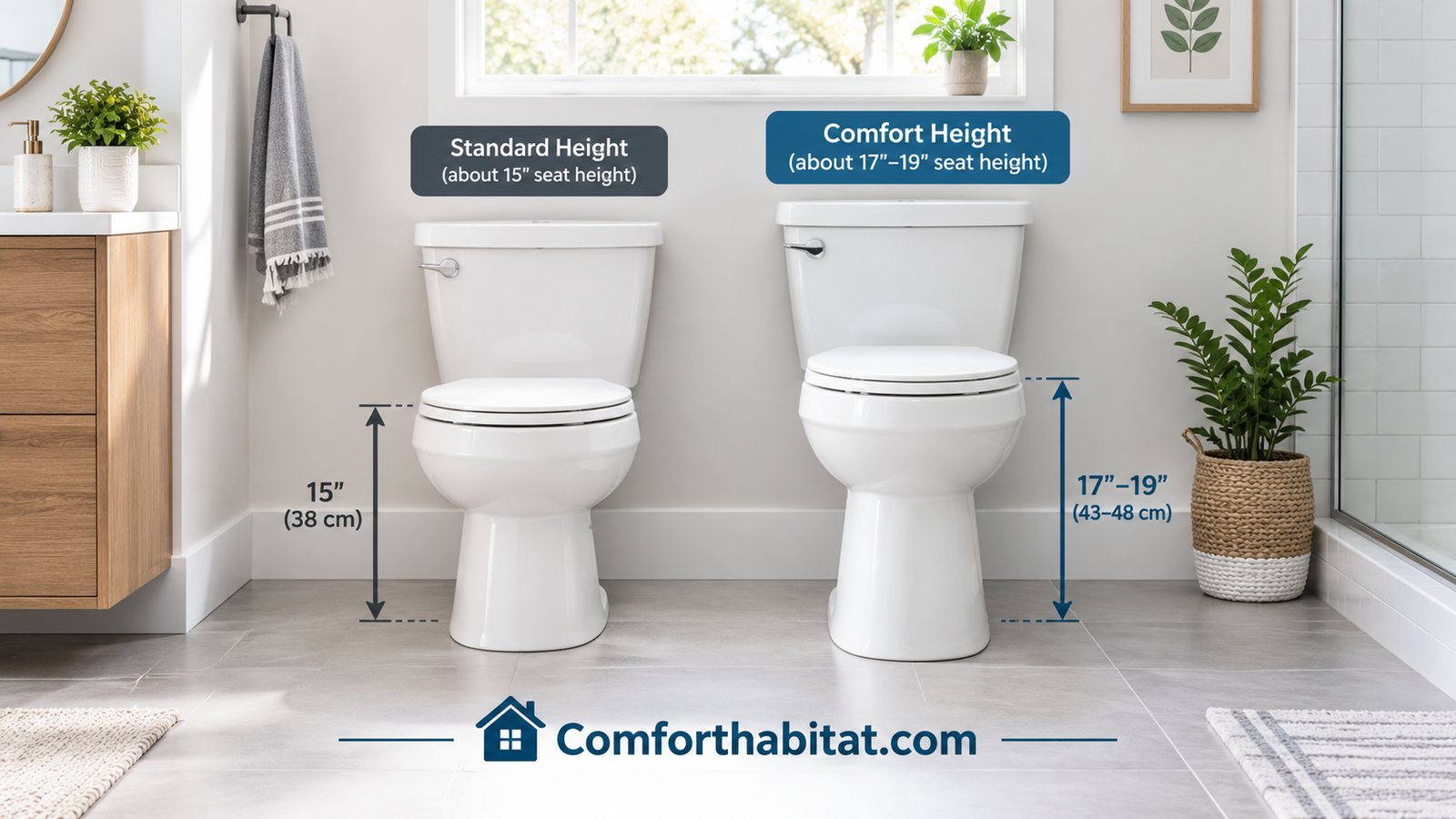
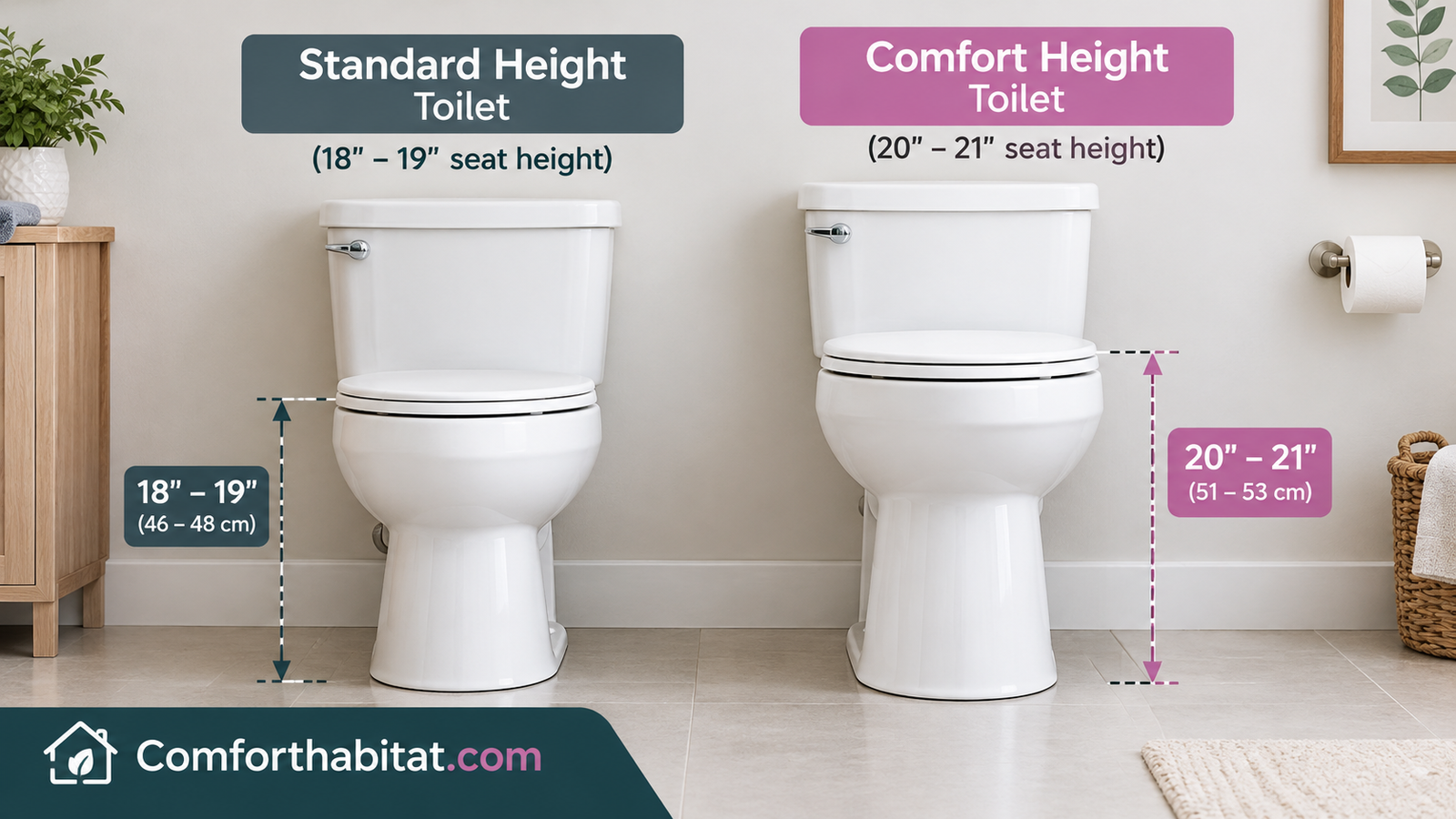
Let us start with definitions, because the names are slightly misleading. A “standard height” toilet is not an official category with a fixed number. It is simply the traditional height most residential toilets have had for a long time: the rim of the bowl usually sits around fourteen to fifteen inches from the floor. With a seat attached, you are typically looking at fifteen to sixteen inches.
A “comfort height” toilet, sometimes called right height, chair height, or universal height, raises the bowl so the rim sits at roughly sixteen and a half to seventeen inches. Add a seat and many models reach seventeen to nineteen inches. That range matters because it lines up with the guidelines used for accessible bathroom design in many places, which is one reason manufacturers promote these toilets as ADA-friendly.
Where the names come from
The phrase “comfort height” was popularized by manufacturers to describe the idea that a toilet should be about as tall as a regular chair. That is the whole concept. A typical dining chair seat sits around seventeen to eighteen inches from the floor, so a toilet at the same level asks your knees and hips to do roughly the same work they do when you sit at a table.
It is only a couple of inches
The difference between the two is usually somewhere between two and three inches. That sounds tiny, and on paper it is. In practice, those few inches change how far you lower your body, how much your legs bend, and whether your feet touch the floor. It is similar to the way a small change in office chair seat height can turn an uncomfortable afternoon into a comfortable one. Small numbers, noticeable effects.
It also helps to know that height alone does not define the experience. Bowl shape, seat style, and even the angle of the tank lid influence how a toilet feels. We will unpack those later. For now, keep the core idea in mind: comfort height means taller, standard height means lower, and both are perfectly normal choices.
Compare options and current prices.
Shop Comfort Height Toilets on Amazon2. Measuring a Toilet the Right Way
Before comparing anything, make sure you are measuring the same way manufacturers do, because mismatched measurements are the source of most confusion. Spec sheets can list the height to the rim of the bowl, to the top of the seat, or to the top of the tank. These are three different numbers.
The measurement that matters for comfort
For comfort, the number you want is the seat height: the distance from the floor to the top of the seat when it is down. Measure it with a tape straight up from the floor beside the toilet. If you are shopping online, check whether the listing quotes the bowl rim or the seat. Many comfort height toilets are advertised by rim height, and the seat then adds roughly half an inch to an inch and a half depending on its thickness.
Measuring your current toilet
- Lower the seat and lid.
- Place the tape measure on the floor next to the bowl.
- Measure straight up to the top of the seat, not the lid.
- Write the number down so you can compare it with any model you consider.
If your measurement is under sixteen inches, you almost certainly have a standard height toilet. If it is seventeen inches or more, you have a comfort height model.
Other measurements worth taking
While you have the tape out, note the rough-in distance, which is the space from the finished wall behind the toilet to the center of the drain flange. Twelve inches is the most common in modern homes, though ten and fourteen exist. Also check the distance from the center of the flange to any side wall or vanity. Most codes want at least fifteen inches on each side, and an extra few inches feels far more comfortable.
These measurements are useful for both types of toilet. The height decision is about comfort, but the rough-in and clearance decisions are about whether the toilet physically fits. Getting both right in advance saves return trips and frustration.
Why accurate measuring prevents returns
Toilets are heavy, bulky, and fragile, which makes returns inconvenient. Spending ten minutes with a tape measure before ordering can prevent a lot of trouble. Photograph the label inside the tank, note the model number, and take a picture of the supply line and shutoff valve. These details help you or a plumber confirm that a replacement will fit, and they let you compare heights accurately across brands.
Compare options and current prices.
Browse Bathroom Measuring Essentials3. How Each One Feels in Daily Use
Specifications only tell part of the story. What most people want to know is how the two heights feel when they use them dozens of times a week.
Sitting down and standing up
On a comfort height toilet, the motion is closer to sitting on a chair. Your knees bend less, your thighs stay closer to horizontal, and the push up requires a smaller range of movement. People who have stiff knees, tight hips, or a bit of lower back tension usually notice the difference immediately. The descent feels shorter and the rise feels easier.
On a standard height toilet, you lower yourself a little further. For many healthy adults that is no issue at all and may not be noticeable. For others, especially anyone who has had joint trouble, that extra depth makes the motion feel more like a squat than a sit.
Foot position
Here is the flip side. On a taller toilet, shorter users may find their feet no longer rest flat on the floor, or only barely. Dangling feet can make sitting feel unstable and can change how comfortable you are for longer sits. A standard height toilet lets more people plant their feet firmly. This is the main reason it remains popular in family bathrooms.
The “first time” effect
If you have only ever used standard toilets, your first few sits on a taller one may feel odd. Most people adapt within days. Likewise, anyone who switches back to a lower toilet at a friend’s home may feel they are sinking a little. This adjustment period is normal and rarely lasts.
Overall impression
If we had to summarize the daily feel in one sentence: comfort height is easier on the body for the transitions, standard height is easier on the feet for the sitting. Which matters more to you depends on your height, your joints, and who else uses the room.
Long-term comfort over months and years
Daily use over months is where preferences settle. Households that switch to a taller toilet often report that they stop noticing it within a couple of weeks, which is exactly the point. A good fixture disappears into the routine. People who move back to a lower toilet, on the other hand, tend to notice the change more sharply, because the extra effort of standing is now back. If you are on the fence, remember that adjusting to a taller seat is usually easier than adjusting to losing one.
It is also worth thinking about the middle of the night. Getting up half asleep, with stiff joints and little light, is when an easier rise matters most. A comfort height toilet lowers the demand of that moment, and a small night light near the floor makes it safer still.
Compare options and current prices.
See Toilet Seat Options on Amazon4. Accessibility, Aging, and Mobility
Accessibility is where comfort height toilets earn most of their reputation. If anyone in your household has limited mobility, uses a cane or walker, or simply finds low seats tiring, the extra height can make a real difference to independence.
Why taller helps
The closer a toilet seat is to the height of a normal chair, the less your legs and arms have to work. Lowering and rising involve the quadriceps, glutes, and hips. When a seat is a bit higher, those muscles lift less of your body weight through a smaller arc. For older adults and people recovering from surgery or injury, this is genuinely helpful.
Accessible design guidelines
Accessible bathroom guidelines in many regions call for a toilet seat height in a range of roughly seventeen to nineteen inches above the floor. Most comfort height toilets fall within or near that range when you include the seat. This is why they are often described as ADA compliant. Keep in mind that a fully accessible bathroom is more than a toilet. Grab bar placement, clear floor space, door width, and turning room all matter, and requirements differ by location and by whether the project is residential or commercial.
Aging in place
If you plan to stay in your home for many years, installing a comfort height toilet is one of the simplest and least expensive aging-in-place upgrades. It does not change the look of the room much, it does not require special plumbing, and it removes one source of daily strain. Paired with sturdy grab bars and non-slip flooring, it contributes to a safer bathroom overall.
When taller is not better
Not everyone with mobility challenges benefits from a higher seat. People with limited height or those who use a footstool may prefer a lower seat for stability. If you are unsure, test a comfort height toilet in a showroom or at a friend’s home before committing.
Pairing the toilet with other safety upgrades
A taller toilet works best as part of a small package of changes. Grab bars on the side wall or behind the toilet give something solid to push against. A non-slip mat or textured flooring reduces the risk when floors are wet. Good lighting, ideally with a motion-sensing night light, prevents missteps. A toilet paper holder within easy reach avoids awkward twisting. None of these items are expensive, and together they turn an ordinary bathroom into a noticeably safer one.
If a family member is recovering from hip or knee surgery, ask the care team about recommended seat heights during recovery. Some people are advised to use a raised seat for a period, and a comfort height toilet can serve that need long after the recovery is over.
Compare options and current prices.
Shop Bathroom Safety Products5. Comfort for Tall and Short Users
Height, in the human sense, plays a surprisingly large role in which toilet suits you. The ideal seat is one where your thighs sit roughly parallel to the floor and your feet rest comfortably on the ground. That position depends on how long your lower legs are.
Taller adults
If you are tall, a standard height toilet can feel like sitting on a low stool. Your knees rise above your hips, your lower back rounds, and getting up requires more effort. A comfort height toilet matches your proportions better. For anyone over about six feet, the taller bowl is often the clear winner, and for very tall users even a model at the high end of the comfort range can feel natural.
Average-height adults
For most adults of average height, both options work. The choice then comes down to joint comfort and personal preference. Many people in this group say they cannot go back to a lower toilet once they have used a taller one, simply because the standing motion feels easier. Others genuinely prefer the lower position and see no reason to change.
Shorter adults
If you are under about five feet three inches, a comfort height toilet may leave your feet hovering. That is not dangerous, but it can feel less supported. A small step stool placed in front of the toilet solves the problem neatly. It lifts your feet, brings your knees to a comfortable angle, and gives you the best of both worlds. Standard height remains an excellent choice for shorter users who prefer not to use a stool.
Mixed-height households
Many couples are different heights, and the right answer is often a compromise. A good approach is to put the comfort height toilet in the primary bathroom and keep a standard height toilet in the guest or kids’ bathroom, or the other way around depending on who uses which room. Where only one toilet exists, a tall-and-short pairing often works best with a comfort height bowl and a simple footstool for the shorter user.
| User height | Typically feels best | Notes |
|---|---|---|
| Under 5’3″ | Standard height | Feet stay flat; a stool helps with comfort height |
| 5’3″ to 5’9″ | Either | Choose based on joint comfort |
| 5’10” to 6’1″ | Comfort height | Easier knee angle and standing |
| Over 6’1″ | Comfort height | Standard can feel noticeably low |
These are general tendencies rather than rules. The best test is always your own experience, so if you can, sit on both types before buying.
Compare options and current prices.
Find a Bathroom Footstool on Amazon6. Kids, Families, and Shared Bathrooms
Families have the trickiest decision, because a single toilet needs to work for a toddler, a teenager, two parents, and sometimes a grandparent. Here is how each option plays out.
Toddlers and potty training
Young children struggle with any adult toilet, and a taller one makes it harder. Climbing up, balancing, and feeling secure all become more difficult when the seat is higher. If you are potty training, a sturdy step stool and a child-size toilet seat insert are almost essential on a comfort height bowl. On a standard height toilet, the stool is still helpful but the climb is shorter.
Older children and teens
By the time kids reach about ten or eleven, most can use either height comfortably. Teenagers who have grown tall tend to prefer the taller one. Because growth happens fast, a comfort height toilet is often something children grow into rather than out of.
Grandparents and guests
If older relatives visit regularly, a comfort height toilet in the guest bath is a thoughtful touch. It helps them feel independent and safe. Guests without any mobility concerns will not notice or mind the extra height.
Practical family setup
A common family arrangement is a comfort height toilet in the main bathroom for adults, and a standard height toilet in the kids’ bathroom. If you only have one bathroom, picking comfort height and adding a stool for younger children tends to serve the household longer. Over time the children will outgrow the need for it, while the adults will keep benefiting from the taller seat.
- Keep a stool handy: choose one with a non-slip surface and a stable base.
- Consider a child seat insert: a magnetic or fold-down insert makes a taller toilet less intimidating.
- Teach step-down safety: kids should hold the edge or a rail when stepping off.
Compare options and current prices.
Shop Potty Training Seats and Stools7. Posture and Body Mechanics
Toilet height also touches on posture, and this is where some of the loudest opinions appear. It is worth separating well-understood body mechanics from internet folklore.
The sitting angle
When you sit on a toilet, your hips and knees form angles that influence how your pelvic floor and abdominal muscles work. On a taller toilet, your knees sit at a wider, more open angle, and your thighs are closer to level. On a lower toilet, your knees rise higher relative to your hips, creating a deeper fold at the hip.
The squat idea
Many people have heard that a squatting posture is more natural for elimination, which is why footstool products that raise the knees above the hips have become popular. Following that logic, a lower toilet bends the hips a little more than a taller one. However, the difference between fourteen and seventeen inches is small compared with the change a footstool makes. If posture is your priority, a footstool on either height will do more than the toilet itself.
Because every body is different and individual health concerns vary, anyone with a specific medical issue should ask a healthcare professional rather than relying on a general article. The aim here is simply to explain the mechanics, not to prescribe a position.
Back, hips, and knees
For the transition movements, the story is clearer. A slightly higher seat reduces the demand on the knees and hips. That is the main reason so many remodelers and therapists mention comfort height toilets when discussing accessibility. It is the same logic that guides ergonomic seating elsewhere in the home, as you will see in our guide to setting up an ergonomic desk, where seat height, knee angle, and foot support all work together.
Using a footstool with either height
A footstool lets you customize the position without replacing hardware. Those who like the ease of a comfort height seat but want knees raised can use a stool of about seven to nine inches. Those on standard height toilets often find a smaller stool is enough. It is a low-cost experiment that can tell you a lot about what feels right.
Everyday habits that help
Beyond height, small habits make a big difference to comfort. Sit with your back relaxed rather than hunched, keep your feet supported, and avoid spending long stretches on the toilet with a phone in hand. A relaxed posture and a calm pace are more helpful than any single product. If you find yourself straining, a footstool, plenty of water, and fiber-rich foods are commonly suggested everyday measures, and persistent trouble is a good reason to speak with a doctor.
Compare options and current prices.
Compare Toilet Footstools on Amazon8. Bowl Shape, Flush, and Design Details
Height is only one piece of a toilet. If you are replacing a toilet, the other features may matter just as much to your daily satisfaction, and they often interact with height choices.
Round vs elongated bowls
Round bowls are shorter from front to back, usually around twenty-eight inches overall, and suit tight bathrooms. Elongated bowls extend to around thirty-one inches and are generally more comfortable for adults. Comfort height toilets are more commonly sold in elongated form, though both shapes exist at both heights. If your bathroom is very small, check the clearance in front of the toilet before choosing elongated.
Flush performance
Modern toilets in both heights commonly use around 1.28 gallons per flush or less, and many carry water-efficiency labels. Performance depends more on the bowl design, trapway size, and flush mechanism than on height. Look for a toilet with a fully glazed trapway, a wide flush valve, and independent testing results. Pressure-assisted and dual-flush options are available at both heights.
One-piece vs two-piece
One-piece toilets have a sleek look and no gap between tank and bowl, which makes them easier to clean. Two-piece toilets are usually less expensive and easier to carry upstairs. Both styles are widely available in comfort height and standard height.
Seats, lids, and extras
Many people overlook the seat. A soft-close seat prevents slamming. A quick-release hinge lets you remove the seat for cleaning. Heated seats and bidet attachments add comfort, though they require a nearby outlet. Cold surfaces can be unpleasant in winter, and the idea of thermal comfort is bigger than most people realize, as explained in our article on what thermal comfort is. A seat with a slightly warmer material or a heated option can make a noticeable difference.
Cleaning and maintenance
Skirted designs hide the trapway and wipe clean in seconds. A taller toilet does not make cleaning harder, but one with a skirted base and a smooth tank lid does. Choose a finish that resists staining and a glaze that stays smooth over the years.
What to look for
- Elongated bowl for adult comfort
- Soft-close seat
- Skirted base for easy cleaning
- Water-saving flush mechanism
What to question
- Very small trapways that clog
- Unlabeled water use
- Thin plastic seat hinges
- Unclear height listings
Compare options and current prices.
Shop Toilet Seats and Bidet Attachments9. Cost, Installation, and Compatibility
Is a comfort height toilet more expensive? Usually only slightly, and often not at all. Because comfort height has become so popular, many leading models are sold primarily in that height. The price difference for the same brand and feature set tends to be small.
Typical price ranges
Basic two-piece toilets in either height can be found at budget-friendly prices, while one-piece, skirted, and dual-flush models sit higher. Premium models with built-in bidet seats cost considerably more. What drives price is the feature set and brand, not the height.
| Category | Standard height | Comfort height |
|---|---|---|
| Basic two-piece | Lowest cost | Similar or slightly higher |
| One-piece skirted | Mid range | Mid range |
| Dual flush | Mid to upper | Mid to upper |
| Smart or bidet seat models | Premium | Premium |
Installation
Installation is virtually identical. Both connect to the same flange and water supply, and both need a wax or rubber seal, closet bolts, and a level surface. A taller toilet does not change plumbing connections. What can change is the supply line length, which may need to be a bit longer or shorter, and the tank height under a window or shelf.
Checking compatibility
- Rough-in: match the twelve-inch standard unless yours is different.
- Clearance: allow space for the tank and lid to open fully under any shelf or window.
- Floor condition: check for soft spots or leaks before installing any new toilet.
- Supply line: pick a braided line sized for your setup.
DIY or hire a pro
Replacing a toilet is a manageable project for a confident DIYer. It takes about two hours, a handful of tools, and some help lifting. If you find rot or corrosion around the flange, call a plumber. Safety and water damage prevention are worth the cost of professional help.
Budgeting for the whole project
The toilet itself is only part of the cost. Add a seat if one is not included, a new wax ring or rubber gasket, closet bolts, a supply line, and perhaps caulk for the base. If you hire a plumber, labor can equal or exceed the price of a basic toilet. Removal and disposal of the old fixture may add a small fee. Setting aside a modest buffer for unexpected issues, such as a corroded shutoff valve, keeps the project stress free.
It also pays to think about longevity. A well-made toilet can last for decades, so a slightly higher upfront cost for a better flush mechanism and a durable finish is usually money well spent. Warranties on china, mechanisms, and finish vary widely, and a longer warranty signals a manufacturer who expects the product to last.
Compare options and current prices.
Get Toilet Installation Supplies10. Side-by-Side Comparison
After covering the details, it helps to see everything in one place. The table below summarizes the main differences between the two toilet types, followed by the honest pros and cons of each.
| Feature | Comfort height | Standard height |
|---|---|---|
| Typical bowl rim height | About 16.5 to 17 inches | About 14 to 15 inches |
| Typical seat height | About 17 to 19 inches | About 15 to 16 inches |
| Sitting and standing effort | Lower | Higher |
| Feet flat for shorter users | Sometimes not | Usually yes |
| Best for tall users | Yes | Can feel low |
| Good for older adults | Excellent | Fair |
| Young children | Needs a stool | Easier, still needs a stool |
| Accessibility guidelines | Usually within range | Usually below range |
| Price | Similar | Similar |
| Installation | Same | Same |
Comfort height
Pros
- Easier on knees and hips
- Better for tall adults
- Fits accessibility guidelines
- Wide model selection
Cons
- Feet may dangle for shorter users
- Harder for toddlers to climb
- May feel too tall at first
Standard height
Pros
- Feet rest flat for most users
- Easier for small children
- Familiar and widely available
- Often a little lower in price
Cons
- Harder to stand up from
- Can feel low for tall adults
- Below accessible seat height range
Looking at the table, you can see why comfort height has become the default choice for most new homes and renovations. It handles more adult users well, and the main drawback, shorter legs, has an easy fix in a footstool. Standard height still wins in specific situations, particularly where children or very short adults are the main users.
Compare options and current prices.
See Top-Rated Toilets on Amazon11. Who Should Pick Which
With all the facts on the table, here is a practical way to decide. Think of it as a short set of scenarios, and see which one sounds like your home.
Choose comfort height if
- You or someone in your home has stiff knees, hips, or back that make sitting and standing difficult.
- You are taller than about five feet ten inches.
- You are planning to age in place or renovating with future needs in mind.
- You want a toilet that meets accessible seat height guidelines.
- Your household mostly consists of adults and teens.
Choose standard height if
- The bathroom is primarily for young children.
- Users are shorter and prefer feet flat on the floor without a stool.
- You are matching an existing set of fixtures and want visual consistency.
- You simply like how a lower seat feels.
Consider both if
You have more than one bathroom. There is no rule that every toilet in a house has to be the same height. A comfort height model in the primary bathroom and a standard model in the children’s bath is a sensible split. In a home with older relatives, put the taller one where they will use it most.
Still undecided?
Visit a showroom, a hardware store with display models, or a friend’s home and try both. Sit for a moment, stand up a few times, and pay attention to your knees and feet. Five minutes of testing beats hours of reading. Once you have a preference, our guide to the best comfort height toilet options can help you narrow down a specific model.
Compare options and current prices.
Browse One-Piece Comfort Height Toilets12. Buying Tips and Mistakes to Avoid
Whichever height you choose, a few practical tips will help you get a toilet you actually enjoy living with.
Confirm the height number
Check whether the listing shows bowl rim height or seat height. If you want a seat at roughly seventeen inches or more, make sure you are looking at the right number. Mixing them up is the most common mistake.
Verify the rough-in
Measure from the wall to the flange bolts. Most homes use a twelve-inch rough-in, and a toilet made for a different measurement will not sit correctly against the wall.
Pick the right bowl shape
Elongated is the better choice for most adults, but measure the space in front of the toilet. A bowl that nearly touches the door or vanity is a daily annoyance, so round may be better in tiny bathrooms.
Look past the marketing
Words like “chair height” and “right height” are not strictly regulated. Always rely on the numbers, not the label. Also check independent flush tests, warranty length, and the quality of the fill valve and flapper, because those are the parts that tend to wear first.
Plan for the seat
Some toilets include a seat and others do not. If the seat is separate, budget for one and check that it fits the bowl shape. A quality soft-close seat adds comfort and extends the life of the toilet.
Mistakes people make
- Buying a tall toilet for a child’s bathroom without planning a stool.
- Ignoring clearance under shelves or windows.
- Choosing by price alone and ending up with a weak flush.
- Forgetting to replace the wax ring and supply line.
- Assuming every “comfort height” toilet is the same height.
Think about the room as a whole
A toilet is part of a larger space, and comfort comes from the combination. Good lighting, comfortable temperature, and sensible spacing all matter. If you enjoy designing comfortable spaces in other parts of your home, you may find our articles on the best office chair for comfort and the best gaming chair for comfort useful for applying the same seat-height thinking elsewhere.
A simple pre-purchase checklist
- Measure the rough-in, clearances, and available height under any tank obstruction.
- Decide who uses the toilet most and settle the height question first.
- Choose round or elongated based on measured space, not appearance.
- Compare flush ratings and water use rather than only price.
- Check what is included: seat, wax ring, bolts, and supply line.
- Read the warranty and the return policy before you order a heavy item.
Following this list keeps the project predictable, and it protects you from the most common surprises that show up on installation day.
Compare options and current prices.
Shop Toilet Parts and UpgradesFrequently Asked Questions
What is the difference between a comfort height and a standard toilet?
The main difference is seat height. A standard toilet has a bowl rim around fourteen to fifteen inches off the floor, while a comfort height toilet sits at about sixteen and a half to seventeen inches. With a seat, comfort height models commonly reach seventeen to nineteen inches. Everything else, including flushing, plumbing, and installation, works the same way.
Is a comfort height toilet better for seniors?
For most older adults, yes. The higher seat means less bending of the knees and hips, so it takes less effort to sit down and stand up. It does not replace other safety features such as grab bars and non-slip floors, but it is a simple upgrade that many people find helpful.
Are comfort height toilets ADA compliant?
Many are designed to meet the seat height range used in accessible design guidelines, which is roughly seventeen to nineteen inches. Compliance depends on the exact model, the seat you install, and the layout of the whole bathroom. Always check the specifications and local requirements for your project.
Are comfort height toilets too tall for short people?
They can be for people under about five feet three inches, since feet may not rest flat on the floor. A small footstool solves this and also raises the knees, which many people prefer. If you would rather not use a stool, a standard height toilet may suit you better.
Can children use a comfort height toilet?
Yes, with help. Toddlers and young children need a sturdy step stool and often a child seat insert to feel secure. Older children usually manage without any aids. If the toilet will mainly serve small children, a standard height model may be more practical.
Does toilet height affect flushing performance?
No. Flush strength comes from the bowl design, trapway, and flush valve rather than from height. A good comfort height toilet and a good standard toilet can perform equally well, so compare flush ratings and independent test results instead.
Are comfort height toilets more expensive?
Usually not by much. Prices vary more by brand and features, such as one-piece construction, skirted bases, dual flush, and bidet seats. Within the same product line, the height difference often adds little or nothing to the price.
Can I replace a standard toilet with a comfort height one myself?
If you are comfortable with basic plumbing, yes. The process is the same as replacing any toilet: shut off the water, drain the tank, remove the old toilet, install a new wax ring, and set and secure the new bowl. Check for floor damage first, and hire a plumber if the flange is damaged.
Do I need to change the plumbing for a taller toilet?
No. A comfort height toilet connects to the same drain and supply lines as a standard one. You may need a different length of supply line, and you should check that the tank fits under any shelf or window.
Should every toilet in my home be the same height?
Not necessarily. Many families use comfort height in the main bathroom and standard height in the children’s bathroom. Choose the height that fits the people who use each room.
Is a comfort height toilet the same as a right height toilet?
Yes, in most cases. Comfort height, right height, chair height, and universal height are brand names for the same idea: a toilet that sits at roughly the height of a regular chair. Always verify the actual measurements, because the terms are not strictly standardized.
Can I make a standard toilet taller without replacing it?
You can use a raised seat or a bolt-on riser to add a couple of inches. These are affordable and require no plumbing. They are best seen as a temporary or budget option, since a properly installed comfort height toilet is more stable and looks cleaner.
Ready to find your perfect toilet height?
Shop Toilets on AmazonConclusion
The comfort height vs standard toilet debate comes down to a simple tradeoff. A taller seat is kinder to the knees, hips, and back and suits taller users, older adults, and anyone planning for the future. A lower seat keeps feet planted for shorter users and is friendlier for small children. Both flush the same, install the same, and cost about the same, so you are really choosing the sitting experience that fits the people in your home.
For most adults, comfort height is the safer long-term choice, and the one drawback, dangling feet, has an inexpensive fix. If your bathroom serves children first, or you simply prefer a lower seat, standard height remains a perfectly good option. Whichever you pick, confirm the real measurements, check your rough-in, and choose a bowl shape that fits your space.
When you are ready to compare models, start with our roundup of the best comfort height toilets and the comfort height toilet explainer for a closer look at features.
Find a toilet that fits your home and your comfort.
Shop Toilets on Amazon