
What Is a Comfort Height Toilet? Everything You Need to Know Before You Buy
A plain-English guide to taller toilets: how high they sit, who they help, how they differ from standard bowls, and what to check before you swap one into your bathroom.
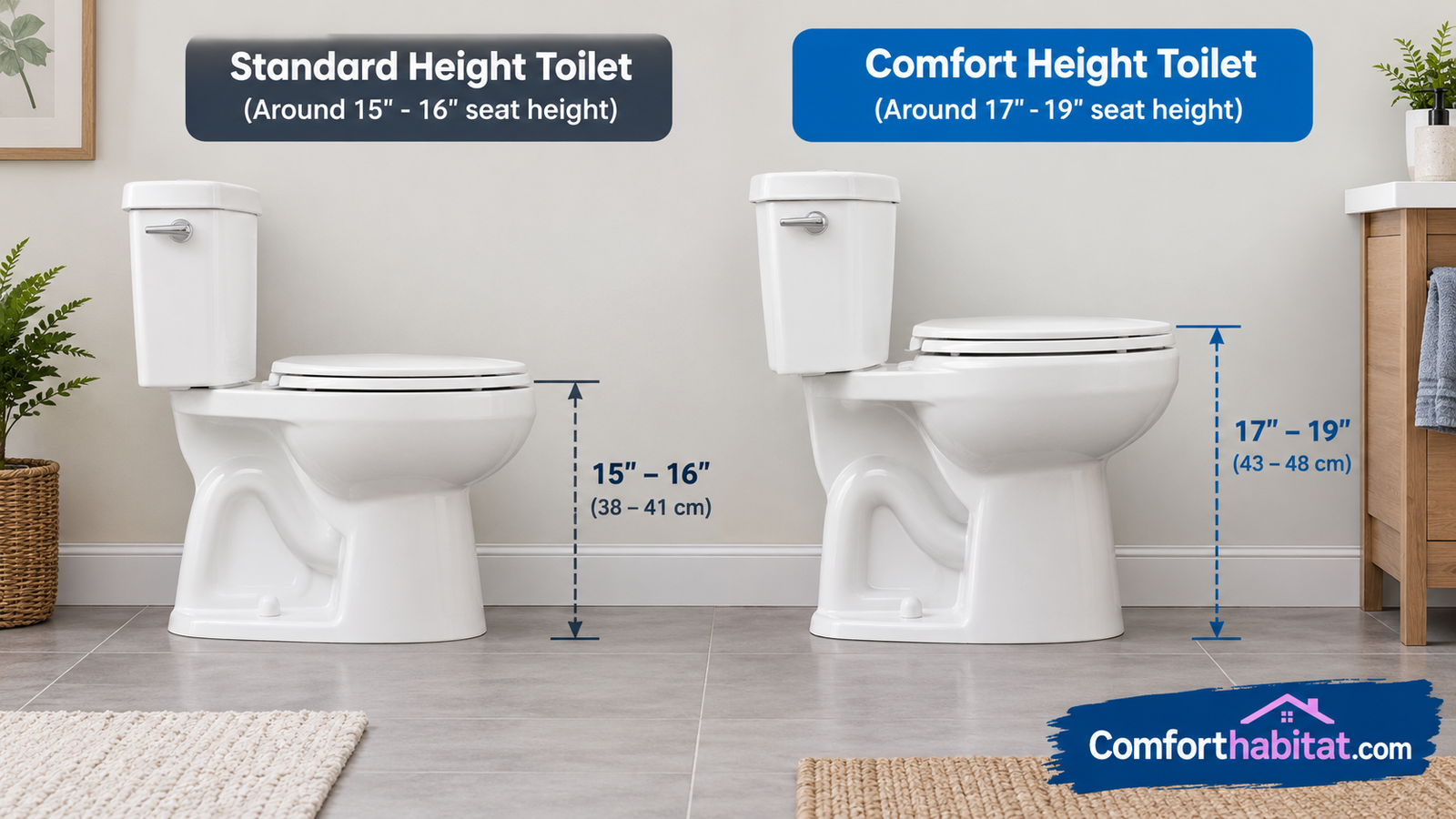
The short answer: a comfort height toilet is a toilet with a taller bowl and seat, usually measuring about 17 to 19 inches from the floor to the top of the seat. A standard toilet sits closer to 14 or 15 inches. That extra two to four inches puts the seat at roughly the same level as a dining chair, which makes sitting down and standing up easier on the knees, hips and lower back.
Walk into almost any bathroom store or browse any online listing and you will see the same phrase over and over: comfort height. It is printed on boxes, shouted in product titles and tucked into spec sheets, yet many shoppers are never told what it really means. Is it a marketing term? A building standard? A feature you pay extra for? The honest answer is that it is a bit of all three, and understanding it will save you from buying a toilet that looks great online but feels wrong the moment you sit on it.
This guide walks through the topic from the ground up. We start with the definition and the actual measurements, then move to the other names you will run into, the differences from a standard toilet, and the people who tend to love the taller design (and the few who do not). From there we cover accessibility standards, bowl shapes, flush features, how to measure your own bathroom, what a replacement involves, and how to think about cost. If you are already past the basics and want product picks, our roundup of the best comfort height toilets pairs well with this article.
1. What a Comfort Height Toilet Actually Is
A comfort height toilet is simply a toilet built taller than the traditional design that dominated homes for most of the last century. The porcelain bowl, and therefore the seat that rests on top of it, sits several inches higher off the floor. Everything else you would expect from a toilet is still there: a bowl, a trap, a tank or pressure-assisted flush, a seat and lid, and a supply line. The only thing that has really changed is the vertical dimension.
Why does that matter? Think about how often you sit down and stand up from a toilet over a lifetime. It is a movement your body repeats many times a day, every single day. On a traditional low toilet, you lower yourself roughly the height of a child’s chair, then push back up from that low position. For a young, healthy adult that is no problem. For someone with stiff knees, sore hips, a recent surgery, or simply a taller frame, it can feel like squatting into a hole and fighting gravity to get out again.
The comfort height design takes a cue from furniture. Most kitchen and dining chairs have a seat that sits somewhere between 17 and 19 inches off the floor, which is no accident. Designers have spent decades refining what height lets most adults sit down and stand up with the least effort. Toilet makers eventually borrowed that logic. If the seat height works for a dining chair, the thinking goes, it should work for a toilet too.
You may also hear the term used loosely to describe any toilet that is taller than standard. In practice, manufacturers apply the label to bowls that fall in a fairly consistent range, and the label has become a shorthand shoppers recognize. That is useful, but it also means the phrase is not tightly regulated on its own. Always check the actual measurement on the spec sheet rather than trusting the words in the title.
A quick look at how we got here
For many years, the default toilet was a low, compact fixture designed mainly around the dimensions of a smaller bathroom and the manufacturing habits of the time. Taller toilets existed, but they were most often associated with medical and accessibility settings, which gave them an institutional reputation. Over time, as the population aged and as people grew more comfortable thinking about long-term home design, the taller bowl moved into the mainstream. Today, many popular models from major brands are offered in a taller version by default, and it is increasingly the standard choice in new builds and remodels.
Keep this in mind: comfort height describes the fixture, not the feeling. A toilet that is technically tall can still feel awkward if the bowl is oddly shaped or the seat is too slim. The number matters, but how it fits your body matters just as much.
Ready to see comfort height models in real life?Browse a wide range of taller toilets and compare bowl heights side by side.
Shop Comfort Height Toilets on Amazon2. How Tall Is a Comfort Height Toilet?
Here is where precision matters. Most comfort height toilets measure between 17 and 19 inches from the floor to the top of the toilet seat. That range is the sweet spot you will see repeated across brands, and it lines up with the height range used in accessibility guidelines for toilets in public and commercial buildings.
A standard height toilet, by contrast, usually measures about 14 to 15 inches to the rim of the bowl, and a little more once you add the seat. You can see how the numbers overlap in a confusing way if you are not careful about where the tape measure starts and stops. That is why so many shoppers end up comparing two numbers that were never measured the same way.
Bowl rim height versus seat height
This is the single most common source of confusion, so it deserves a careful explanation. Some manufacturers publish the height of the bowl rim alone, meaning the top edge of the porcelain where the seat will sit. Others publish the height with the seat installed. A seat typically adds somewhere around an inch of height, though thicker cushioned or soft-close seats can add a bit more.
So a bowl that is listed at 16.5 inches to the rim might sit near 17.5 inches once a seat is on it. That would put the finished toilet right inside the comfort height range even though the headline number looked a little short. The reverse also happens: a toilet advertised at 17 inches “with seat” may feel noticeably lower than a competitor that lists 17 inches to the rim. Whenever you compare models, confirm which measurement the manufacturer is quoting.
| Toilet type | Typical height to top of seat | Common use |
|---|---|---|
| Standard height | About 14 to 16 inches | Traditional homes, kids’ bathrooms, tight spaces |
| Comfort height | About 17 to 19 inches | Most modern homes, remodels, everyday family use |
| Extra tall or “tall” models | About 19 to 21 inches or more | Very tall users, certain medical needs |
These figures are typical ranges, not strict rules, and individual models vary. Treat the table as a map of the territory and use the actual spec sheet for the toilet you are considering.
How to picture the difference
Stand next to a dining chair in your kitchen. The seat of that chair is probably very close to the height of a comfort height toilet. Now picture the seat of a low coffee table or a sturdy footstool: that is closer to where a traditional toilet sits. When you put it that way, the appeal becomes obvious. Most people sit in a chair-height seat dozens of times a day without a second thought, and the comfort height toilet is designed to feel just as natural.
The same logic shows up across the home. If you have ever fine-tuned your seat at a desk, you already know that a few inches can transform how a seat feels. We cover the same idea for workspaces in our guide on how to adjust an office chair, and the principle is identical here: the right height reduces strain and makes movement feel effortless.
Want to compare heights quickly?Search ADA and chair height models and check the listed seat height on each product page.
Compare Chair Height Toilets on Amazon3. Chair Height, Right Height, ADA: The Many Names for the Same Idea
If you have ever felt that toilet shopping is full of overlapping jargon, you are not imagining it. Different brands use different labels for essentially the same thing, and the lack of a single universal term is part of why shoppers get tangled up. Here are the names you are most likely to see.
- Chair height: a descriptive term that emphasizes the similarity to a standard chair seat. It is probably the most intuitive label of the bunch.
- Right height: a branded phrase used by some manufacturers for their taller bowls. It means the same basic thing as comfort height.
- ADA height or ADA compliant: a label tied to accessibility guidelines for toilet seat height. We unpack this properly in a later section.
- Universal height: a marketing term suggesting the toilet works for a wide range of users and abilities.
- Tall toilet or elevated toilet: broader terms that sometimes include models taller than the usual 17 to 19 inch window.
- Comfort height: the term this guide focuses on, and the one most widely recognized by shoppers.
In most listings, these phrases are interchangeable in practice. The risk is assuming they are interchangeable in every case. A product marketed as “universal height” may land a little under or over the range you expect, and “ADA compliant” carries a slightly more specific meaning that depends on how the toilet is installed, not just how it is built.
Why the labels matter less than the measurement
The smartest habit you can build is to ignore the label and read the number. If the spec sheet lists a seat height between 17 and 19 inches, you are looking at a comfort height toilet regardless of what the marketing calls it. If the sheet does not list a height at all, that is a small red flag, and it is worth checking the manufacturer’s website or contacting the seller before you commit.
It also helps to know that elongated and round bowls come in both heights. Bowl shape and bowl height are separate choices. A lot of shoppers assume that comfort height automatically means elongated, or the reverse. It does not. We break down bowl shapes further in section eight, but for now just remember that height and shape are two independent decisions.
A handy rule of thumb: if you can only trust one thing in a product listing, trust a measured seat height in inches. Names change from brand to brand, but inches never lie.
See how the labels line up in real listings.Search for right height and ADA height toilets and compare the specs.
Browse ADA Height Toilets on Amazon4. Comfort Height vs Standard Height: How They Really Compare
The difference between the two designs comes down to a few inches, but those inches ripple through comfort, accessibility, aesthetics and even how a bathroom feels visually. We go much deeper in our dedicated breakdown of comfort height vs standard toilets, so treat this section as the overview.
| Factor | Comfort height | Standard height |
|---|---|---|
| Seat height | About 17 to 19 inches | About 14 to 16 inches |
| Sitting down and standing up | Easier on knees, hips and back | Requires a deeper squat |
| Best for | Adults, older users, taller people, accessibility needs | Young children, very short adults |
| Foot position when seated | Feet may dangle slightly for shorter users | Feet rest flat on the floor |
| Accessibility alignment | Often meets accessible height guidelines | Usually does not |
| Visual feel | More substantial, modern look | Lower, more compact profile |
| Availability | Widely available across brands | Still available, but less featured |
The comfort argument
Most adults find the taller seat noticeably easier to use. Because your knees bend less on the way down, the movement asks less of your quadriceps and joints. People who deal with stiffness often describe the change as one of those upgrades they did not know they needed until they had it. Taller adults, in particular, tend to feel like they are no longer folding themselves down onto a seat designed for someone much shorter.
The case for staying standard
Standard height is not obsolete. For young children, a lower seat lets feet rest on the floor, which provides stability and confidence while they learn. Some shorter adults also prefer a lower seat because their feet touch the floor flat, which they find more natural. In a guest bathroom designed mainly for children, or in a household where most users are on the shorter side, the lower bowl can still make sense.
There is also the matter of habit. If everyone in your home has used a standard toilet for years and nobody complains, you may not need to change anything. The question is not which design is objectively better. It is which one suits the people who will actually use the bathroom.
Thinking about temperature and comfort
Comfort in a bathroom is not only about height. Cold seats, drafty floors and poor ventilation all change how a room feels. If that topic interests you, our explainer on what thermal comfort is shows how temperature, airflow and humidity shape the way a space feels, and it applies to bathrooms just as much as living rooms.
Not sure which height fits your household?Compare taller and standard toilets and read real owner feedback.
Compare Toilet Heights on Amazon5. Who Benefits Most From a Taller Toilet
A comfort height toilet is not a niche product for a narrow group. It tends to help a surprisingly wide range of people, and often in ways they only notice after switching. Here are the groups who most often report a real difference.
Older adults and people planning to stay in their homes
As we age, the muscles and joints that handle lowering and lifting the body gradually lose some strength and flexibility. A taller seat shortens the distance you have to travel, which reduces the effort involved. For people who want to stay in their own homes for as long as possible, a taller toilet is one of the simplest and most affordable changes that can make daily life easier. It is also a change that does not look clinical. A modern comfort height bowl looks like any other contemporary toilet.
Taller adults
If you are well over six feet tall, a standard toilet can feel like sitting on a toddler’s potty. Your knees rise higher than your hips, which is neither comfortable nor especially natural. A taller seat lets your legs fall into a more relaxed position, and most taller users say it feels like the toilet was finally made for them.
People with joint pain, arthritis or limited mobility
Anyone who deals with sore knees, hips or a stiff lower back may find the lower seat painful to use. Reducing the depth of the squat can take pressure off sensitive joints. This is general comfort information, not medical advice, and anyone with a specific condition should talk to a healthcare professional or an occupational therapist about the best setup for their needs.
People recovering from surgery or injury
After hip, knee or back procedures, doctors and therapists often recommend a raised seat for a period of time. A permanent comfort height toilet removes the need for a temporary riser and gives you a stable, properly installed fixture instead of an add-on that can slide or wobble.
Pregnant women
Many people find that a taller seat is easier to get on and off during pregnancy, simply because it requires less bending and pushing. It is a small thing, but small things add up when your body is already working hard.
Anyone who wants a more modern, comfortable bathroom
Plenty of people choose a taller toilet with no specific need at all. They simply like how it feels. If you are already renovating, the cost difference between a standard and a comfort height model is often small, so choosing the taller option is an easy way to add long-term usability for very little extra spend.
Planning ahead pays off. Even if nobody in your home currently struggles with a low toilet, choosing a comfort height model during a remodel is a form of quiet future-proofing. It costs very little now and may save a more disruptive change later.
Looking for something easier on the joints?Explore taller toilets built for everyday comfort and long-term use.
Shop Tall Toilets for Easy Use on Amazon6. The Honest Pros and Cons of a Comfort Height Toilet
No fixture is perfect for everyone, and a trustworthy guide should say so. Here is a balanced look at what you gain and what you might give up.
Pros
- Easier to sit down on and stand up from
- Less strain on knees, hips and lower back
- More comfortable for taller adults
- Often aligns with accessible height guidelines
- Widely available in many styles and price points
- Looks modern and substantial in the bathroom
- Helpful for long-term and aging-in-place planning
Cons
- Feet may dangle for shorter adults and children
- May need a footstool for some users
- Some people find the taller seat less natural for posture
- Slightly taller overall profile, which matters under low windows or sloped ceilings
- Costs a little more than the cheapest standard models in some cases
Common myths worth clearing up
Myth: comfort height toilets are only for older people. They are popular with all ages. Many younger adults choose them simply because they are more comfortable, and they are common in new construction.
Myth: they look like hospital fixtures. That may have been true decades ago, but modern bowls are styled like any other contemporary toilet. Most guests would never notice the height difference unless they sat down.
Myth: a taller toilet is automatically better for your posture. This one deserves honesty. Some people argue that a lower seat, or a footstool that raises the knees, can put the body in a more natural position for bowel movements. The evidence is a matter of ongoing discussion, and individual bodies differ. A taller toilet is better for ease of sitting and standing, which is a separate question from posture during use. If posture matters to you, a small footstool works nicely with a taller toilet and gives you the best of both worlds.
Myth: the toilet will not fit in a small bathroom. Height and footprint are different things. A comfort height toilet has the same floor footprint as a standard model of the same shape, so it usually fits in exactly the same space.
Want a footstool to pair with your taller bowl?A simple stool can solve the dangling feet issue in seconds.
Shop Toilet Footstools on Amazon7. ADA Rules and Accessibility Basics
The phrase “ADA compliant” appears on a huge number of toilet listings, and it causes more confusion than almost any other term in the category. Let’s separate what it does and does not mean.
The Americans with Disabilities Act sets accessibility standards for public and commercial buildings. Those standards include guidance on toilet seat height, generally specifying that the top of the seat should fall within a range of 17 to 19 inches above the finished floor. That is the origin of the 17 to 19 inch window you see on so many comfort height toilets, and it is why many manufacturers label their taller models as ADA height.
Why “ADA height” is not the same as “ADA compliant”
Here is the subtle part. A toilet can have an ADA-friendly seat height without making an entire bathroom compliant. True accessibility compliance involves much more than the fixture itself. It covers clearance around the toilet, the placement of grab bars, the position of the flush control, door width, turning space and more. The toilet is one piece of a larger system.
For most homeowners, this distinction rarely matters in a legal sense because private residences are generally not subject to the same requirements as commercial spaces. Still, building codes and local rules vary, and anyone designing a bathroom for a business, a rental with accessibility obligations, or a specific medical need should check current requirements with a qualified professional.
What accessible design adds beyond height
- Clearance: enough open floor space beside and in front of the toilet for a person to maneuver, including with a mobility aid.
- Grab bars: securely mounted bars that give users something stable to hold when sitting or standing.
- Flush controls: placement on the open side of the toilet and easy to operate without tight grasping or twisting.
- Seat design: a sturdy seat that does not slip, and in some cases an open-front style for specific needs.
If you want a toilet that supports independence over the long term, think of comfort height as the foundation and then layer in the other elements as needed. Even in a regular home, a few well-placed additions can make a bathroom feel more secure for everyone.
Quick reality check: if you need to meet a legal accessibility standard, the product label alone is not enough. Confirm the requirements for your location and your type of building before you buy or install anything.
Building a more accessible bathroom?Look at ADA height toilets and compatible grab bars in one search.
Shop Accessible Bathroom Essentials on Amazon8. Bowl Shape, Build Style and Flush Features
Once you have decided that a taller seat is right for you, a second layer of choices opens up. Height is only one of several features that shape how a toilet looks and feels. Here are the main ones worth understanding.
Round vs elongated bowls
A round bowl is shorter from front to back and is a good option when space is tight. An elongated bowl extends a couple of inches further and is generally considered more comfortable by adults, since it offers more seating surface and a more supportive shape. Elongated bowls take up more room, so in a very small bathroom you will want to measure carefully. As noted earlier, either shape is available in a comfort height version.
| Feature | Round bowl | Elongated bowl |
|---|---|---|
| Front-to-back length | Shorter, more compact | Longer, roughly two inches more |
| Comfort for most adults | Good | Often preferred |
| Best for | Small bathrooms and powder rooms | Standard and larger bathrooms |
| Space needed | Less | More |
One-piece vs two-piece construction
A one-piece toilet has the tank and bowl molded as a single unit. It tends to look sleeker, has fewer crevices where grime can collect and is usually easier to wipe clean. It is also heavier, so installation is a two-person job. A two-piece toilet has a separate tank and bowl joined by bolts. It is usually less expensive, easier to carry in pieces and simpler to repair or replace parts on, though the seam between the tank and bowl is one more place to clean.
Flush systems
Modern toilets use a few different flushing approaches, and the right one depends on your plumbing and your priorities.
- Gravity-fed: the most common system. Water in the tank drops into the bowl and pulls waste through the trap. It is quiet, reliable and easy to maintain.
- Pressure-assisted: uses compressed air to push water with extra force. It is powerful and good at preventing clogs, though it tends to be louder.
- Dual flush: offers a lighter flush for liquid waste and a stronger one for solid waste, which helps save water over time.
- Tornado or vortex style: directs water around the bowl in a swirling pattern to clean more of the surface with each flush.
Water efficiency
Look for a toilet that uses about 1.28 gallons per flush or less. Many efficient models also carry a WaterSense label, which indicates the toilet has been independently tested for both water savings and flushing performance. Modern efficient toilets work very well, and the old reputation for weak low-flow flushes is largely a thing of the past.
Skirted designs and other extras
A skirted toilet has a smooth, enclosed base that hides the trapway. It looks clean and is easy to wipe down. Other features worth considering include soft-close seats that lower quietly, easy-clean glazes that resist staining, and slim-profile tanks that save a bit of space behind the toilet. None of these are essential, but they can make daily use more pleasant.
Comfort is not just about the toilet, either. If you enjoy thinking about how furniture and fixtures work together, you may like our look at how the right chair can change a room in the best office chairs for comfort guide, which covers many of the same principles of fit and support.
Want a one-piece with a soft-close seat?Search elongated, one-piece, comfort height models and filter by features.
Shop One-Piece Comfort Height Toilets on Amazon9. Measuring Your Space Before You Buy
A great toilet that does not fit your bathroom is just an expensive headache. Spending ten minutes with a tape measure before you shop can prevent returns, delays and an unplanned trip to the hardware store. These are the measurements that matter most.
Rough-in distance
The rough-in is the distance from the finished wall behind the toilet to the center of the drain opening in the floor, also called the flange. The most common rough-in in modern homes is 12 inches, though older houses sometimes have 10 or 14 inch rough-ins. Measure from the wall, not from the baseboard, to the center of the bolts that hold the current toilet down. If you measure to the baseboard, you may come up short by half an inch or more.
The good news is that comfort height has no effect on rough-in. Taller and standard toilets are built for the same drain positions, so choosing a taller bowl does not require changing your plumbing.
Space to the side walls and in front
Measure from the center of the drain to the nearest side wall, vanity or tub. A comfortable minimum is generally around 15 inches from the center line to any obstruction, and more is better. Then check the open space in front of the toilet. You want enough room to stand, turn and sit without bumping your knees against a door or cabinet. Building codes in your area may set specific minimums, so it is worth checking local rules if you are doing a full remodel.
Overall height under windows, shelves and tanks
This is where the taller design can occasionally cause a surprise. Because the whole fixture sits a bit higher, the top of the tank is also higher. If your toilet sits beneath a low window, a shelf, a cabinet or a sloped ceiling, measure the clearance. A taller toilet may leave very little room for the lid to lift or for you to reach the flush handle comfortably.
Door swing and walkway
Open the bathroom door fully and make sure the new toilet, especially an elongated bowl, will not block it. Walk the path from the door to the toilet and imagine moving around with the fixture in place. It sounds simple, but a few inches can decide whether a bathroom feels spacious or cramped.
A simple measurement checklist
- Rough-in from the finished wall to the center of the flange bolts
- Center of the drain to the nearest side wall or fixture
- Open space in front of the bowl to the door or vanity
- Height of any window, shelf or cabinet above the tank
- Existing bowl shape, so you can decide whether to keep or change it
- The height at which you personally feel comfortable sitting
Test before you commit. Sit on a comfort height toilet at a friend’s house, a hotel or a showroom if you can. A short sit tells you more than a page of specs, especially if you are on the fence about the extra inches.
Know your rough-in? Start shopping.Filter by 12 inch rough-in and compare compatible taller models.
Find 12 Inch Rough-In Toilets on Amazon10. What Changes When You Replace a Toilet
Swapping an existing toilet for a comfort height model is one of the more approachable bathroom upgrades, but it helps to know what to expect. Many homeowners do it themselves in an afternoon, while others prefer to hire a plumber. Either way, a few realities are worth understanding before the old toilet comes out.
What stays the same
Because rough-in and footprint remain the same, the drain, the water supply line and the mounting bolts usually line up just as they did before. In most homes, you do not need to cut into the floor or move any pipes. The new toilet simply sits in the same spot as the old one, only a bit taller.
What may need attention
- The wax ring or seal: a new one is almost always recommended, since an old seal can fail once disturbed. Some taller bowls with deeper horns use a thicker or extended wax ring, so check the manufacturer’s guidance.
- The closet flange: inspect it for cracks, corrosion or an uneven surface. The flange should sit securely at floor level, since a loose or damaged one can cause leaks.
- The water supply line: a taller tank sits slightly higher, so confirm your existing line reaches the new fill valve without strain. A fresh braided line is inexpensive and a smart replacement.
- The shutoff valve: if it is old, stiff or leaking, this is the ideal moment to replace it.
- The floor underneath: check for softness or staining. A soft spot can mean a hidden leak that deserves repair before a new toilet goes on top.
Weight and handling
A one-piece comfort height toilet can weigh as much as seventy pounds or more, and porcelain does not forgive a dropped corner. Plan to have a helper, use proper lifting technique, and lay down a protective surface where you will set the old and new fixtures. Two-piece models are easier to carry because the tank and bowl travel separately.
Hiring a professional
If you are not comfortable with plumbing, hiring a licensed plumber is a perfectly reasonable choice, and the labor for a straightforward swap is usually modest. A professional can also spot hidden problems like a rotted subfloor or a failing drain connection that a casual look might miss. If you are on the fence, ask for a quote before you decide.
One last practical note: when the new toilet is in, run several flushes and check every connection for drips. Dry the base and supply connections, then check them again after a day. A small, slow leak that goes unnoticed can cause major damage over time.
Replacing a toilet soon?Pick up a fresh wax ring, braided supply line and mounting hardware alongside your new bowl.
Shop Toilet Installation Kits on Amazon12. Cost, Value and Smart Buying Tips
Comfort height toilets span a wide price range, from budget-friendly two-piece models to premium one-piece designs with advanced features. The good news is that taller height rarely adds much on its own. What drives the price is usually everything around it: construction, flush technology, finish quality, brand name and extras like soft-close seats.
What influences price
- One-piece vs two-piece: one-piece toilets generally cost more because of the more complex manufacturing and the sleeker design.
- Flush system: pressure-assisted and dual flush models tend to cost more than basic gravity-fed ones.
- Glaze and finish: premium glazes that resist stains and are easier to clean can raise the price.
- Seat quality: soft-close and quick-release seats are convenient, and cheaper models may leave them out or include a thinner seat.
- Brand and warranty: established brands often back their products with longer warranties and easier access to replacement parts.
Where to spend and where to save
If you are working with a budget, put your money into flush performance and build quality. A toilet that clogs or runs constantly will annoy you every day, while the difference between a plain and an upgraded seat is easy to fix later. You can often add a nicer seat afterward for a modest price, but you cannot easily upgrade the flush performance of a weak bowl.
Check the details before you click buy
- Confirm whether the seat is included. Some listings sell the bowl and seat separately.
- Verify the rough-in, and make sure it matches your measurement.
- Check whether the listed height is to the rim or to the top of the seat.
- Look at the gallons per flush and any water efficiency labeling.
- Read recent reviews for patterns on clogging, finish quality and shipping damage.
- Review the warranty and the return policy, since toilets are heavy and returns are not simple.
Take the next step
When you are ready to move from learning to choosing, our detailed roundup of the best comfort height toilets compares standout models across budgets, bowl shapes and features, so you can narrow down your options quickly. And if you are still weighing the two heights against each other, revisit the full comfort height vs standard toilet comparison.
Ready to pick yours?See top-rated comfort height toilets across every style and budget.
See Top Comfort Height Toilets on AmazonFrequently Asked Questions About Comfort Height Toilets
What is a comfort height toilet?
A comfort height toilet is a toilet with a taller bowl and seat, generally measuring about 17 to 19 inches from the floor to the top of the seat. It is designed to sit at roughly the same height as a standard chair, making it easier to sit down and stand up compared with a traditional lower toilet.
How tall is a comfort height toilet in inches?
Most comfort height toilets measure between 17 and 19 inches to the top of the seat. Standard toilets usually fall between 14 and 16 inches. Always check whether a manufacturer lists the height to the bowl rim or to the top of the seat, since the two numbers can differ by about an inch.
Is a comfort height toilet the same as an ADA toilet?
They overlap but are not identical. Accessibility guidelines call for a toilet seat height of roughly 17 to 19 inches, and many comfort height toilets fall inside that range. However, a fully accessible bathroom also involves clearances, grab bars, flush control placement and more, so the toilet height alone does not make a bathroom compliant.
Are comfort height toilets better than standard toilets?
It depends on who uses them. For most adults, especially taller people and those with joint stiffness, the taller seat is easier and more comfortable. For small children and some shorter adults, a standard height may feel more natural because their feet rest flat on the floor.
What is the difference between chair height and comfort height?
In practice, there is no meaningful difference. Chair height, comfort height, right height and universal height are different labels for taller toilets that sit near the height of a standard chair. The measured seat height is a better guide than the name on the box.
Do comfort height toilets fit in a small bathroom?
Usually yes. Height does not change the floor footprint, so a comfort height toilet takes up the same space as a standard toilet of the same bowl shape. If space is tight, choose a round bowl instead of an elongated one and check the clearance under any low window or shelf above the tank.
Will I need to change my plumbing to install a comfort height toilet?
In most cases, no. Rough-in distance and drain position are separate from bowl height, so a taller toilet generally uses the same connections as the toilet it replaces. You should still use a fresh wax ring, inspect the flange and make sure the supply line reaches the new fill valve.
Are comfort height toilets good for seniors?
Many seniors find them easier to use because the shorter distance to sit and stand reduces strain on the knees, hips and back. They are a common choice for people who want to stay in their homes long term. Anyone with specific mobility concerns should also consult a healthcare professional or occupational therapist.
Are comfort height toilets good for kids?
They can be harder for small children because their feet will not reach the floor. A sturdy step stool and a child-size seat insert usually solve the problem. Some families keep a lower toilet in a kids’ bathroom if they have the space.
Do taller toilets cost more?
Not by much. Price is driven more by construction, flush system, finish and features than by height. In many cases a comfort height model costs about the same as a similar standard model, which is why they are so common in remodels and new builds.
Can I put a comfort height toilet in any bathroom?
Most bathrooms can accommodate one, provided you measure your rough-in, side clearance and overhead space first. Pay particular attention to low windows, shelves or sloped ceilings above the tank, since the taller fixture raises the tank as well.
Is it better to have a footstool with a comfort height toilet?
Many people like pairing the two. A small footstool supports the feet of shorter adults and children, and some users prefer it for the way it changes their seated position. It is inexpensive, easy to store and simple to try without any commitment.
Final Thoughts: Is a Comfort Height Toilet Right for You?
A comfort height toilet is, at its heart, a simple idea: raise the seat a few inches so that sitting down and standing up feel more like using a chair. That small change can make a real difference for older adults, taller people, anyone with sore joints, and plenty of ordinary households that simply want a more comfortable bathroom. It does not require new plumbing, it fits in the same space as a standard model, and it usually costs about the same.
It is not the perfect answer for every home. Small children and some shorter adults may need a footstool, and a household with very mixed heights may need a little creativity. The best approach is to measure your space, think honestly about who will use the toilet, and choose a height that works for the people in your home today and in the years ahead.
If you are ready to start shopping, take a look at our best comfort height toilet picks or browse current options below.
Pingback: Comfort Height vs Standard Toilet: Which to Pick?